
Zumaia
Guipúzcoa · País Vasco
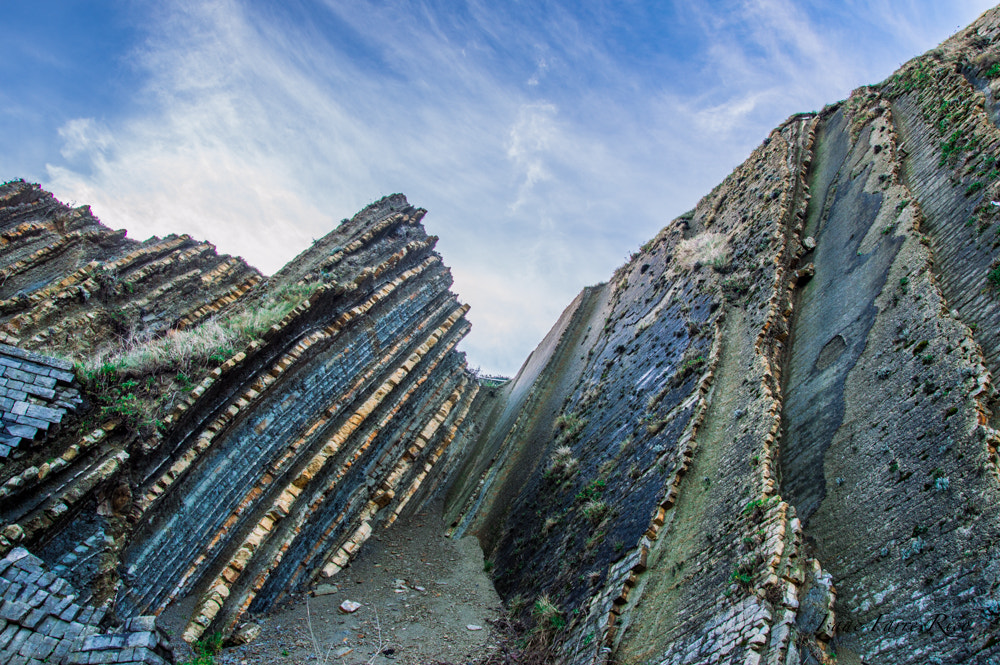
Zumaia ([s̻umaja], Spanish: Zumaya) is a small town in the north of Spain in the Basque Country. The town has two beaches (Itzurun and Santiago), which are of interest to geologists because they are situated among the longest set of continuous rock strata in the world. These formations are termed flysch and they date from the mid-cretaceous period to the present, a time period of over 100 million years. The K–T boundary is present at the Itzurun beach, and fossils can be found, notably of ammonites. The strata stretches along a distance of about 8 km, between the beaches of Deba and Getaria, with Zumaia lying in the middle. The town is also the home-turned-museum of the painter Ignacio Zuloaga. Exhibits include works by El Greco, Rivera, Zurbarán and Goya. Across the street there is a museum of craft and hand-crafted products of Laia. Within the city centre, the Basque-style Gothic church of San Pedro can be found. It has a temple with a magnificent reredos by Juan de Antxieta, the only work by this Basque sculptor found in Gipuzkoa. Zumaia is located at the point where the Urola and Narrondo rivers come together. The origins of the town can be traced by its ancient monastery. In the Middle Ages, the people who lived in the Sehatz valley having to endure the continuous attacks of pirates and pillagers, fortified the city. The church today retains the relic of its defensive appearance.
Sections the premium town hall can edit · Fixed sections of the guide
Origins
There's no information in this section yet. The village's profile can complete it from the panel.
History
Founding:
Despite the disagreements in certain aspects with regard to the origins of Zumaia, all historians agree that the villa emerged surrounding the Monastery of Santa Maria. According to the first preserved parchment in which is mentioned the place "Zumaya", the Monastery of Santa Maria had been a donation by a privilege of Sancho VI of Navarre to the Roncesvalles's convent in 1292.
Despite the different conclusions about the emplacement of the monastery, the monks of the Monastery of Santa Maria the direct witnesses of the birth of this villa, after the inhabitants dispersed by the valley of Sehatz decided to put an end to the continuous assaults of piracy and plunder and raise a villa walled and strengthened from where they could defend in group against the enemy. Due to its extent, its strategic location and its direct contact with the sea, the chosen place was Zumaia. Nevertheless, the villa was not constituted juridically until 1347, when Alfonso XI of Castile provided the municipal charter to its citizens of "Villagrana de Zumaya's Villa", to which was granted the Jurisdiction of San Sebastián.
In the 16th century, Zumaia relied on 136 houses, 70 of them distributed among six streets that existed inside the wall, and the remaining ones dispersed by three neighborhoods that were staying out of the wall. In total there were 108 neighborhood surnames, 53 of them with the qualification of nobility. Nowadays there is no evidence of the fortification that only was interrupted at a height of solar houses and towers that could play the same function of defending as the wall. The entrance halls included the Principal Entrance Hall of the villa and the great cross that presided over them. They were destroyed in the middle of the 18th century to clear the surroundings of the town. The only natural door was that of the bar of the sea, which was apparently the most dangerous for being the most accessible.
Since the 16th century the bells of the parish have been melted many times. In 1578 the mayor ordered to ring them three times consecutively so that citizens were well-informed and came more assiduously to the meetings of the regiment, which was retired long time ago. Moreover, on the eve of the General Meetings—that were celebrated in the villa every 18 years, to offer fuel-wood and coal to the secretary of the province—two oaks were cut. In one of these sessions, on 27 December 1620, the same day in which Ignatius of Loyola, Patron Saint of Gipuzkoa was chosen, the patron saint of the town was named as the Immaculate Conception of the Virgin Mary.
Economic changes and development:
With the pass of centuries, has brought logically many changes not only in the former ordinances municipal written in 1584, but also in the urban development as well as in the customs and way of living of citizens. However, the best keys to notice the development of the villa from its foundation to the present day, is the economic predominant activity of every epoch. The majority of the first inhabitants of the villa were devoted to agriculture, though grouping in the same place accelerated the appearance of some professional and industrial activities. By the end of the 14th century, ships were constructed in the river. A high percentage of the population was devoted to fishing and navigation. The river was then very rich and many species could be fished, among them salmon, trout, shellfish and eels. Many were reconciling the coastal fishing with agriculture. By then, the manufacturing of cement had also become a relevant activity, for which they were taking advantage of the matters of tertiary areas of the surroundings. From the port they were departing goods towards the Netherlands as well as manufactured products were imported. Some historians even claim that the passenger liner that was joining the villa with the hermitage of Santiago – habitual accommodation of the pilgrims who were going towards Santiago de Compostela, were also among the most prominent sources of Zumaia's revenue in the 16th century.
The following centuries, 17th century and the 18th century, were not brilliant periods at all. The land continued being the principal economic activity of the neighbors, in spite of the fact that Zumaia continued having many deficits in agriculture, especially in the production of wheat, corn and beans; until that in 1766 all the houses were recognized to verify if any neighbor possessed more grain than the necessary for their maintenance. There were also citizens dedicated to both maritime and terrestrial transport of goods, mainly iron, and the fishing activity was maintained and even increased, since in 1610 was created the Cofradía de Mareantes de San Telmo, meaning the Confraternity of the Seagoing of San Telmo.
It was in this period when there was emphasized the emigration begun at the end of the 16th century (in 1616 Zumaia embraced 935 inhabitants) and it did not stop until two centuries later with the economic reappearance.
The situation began to improve very quickly in the 17th century, among other reasons because the desiccation of the marshes enabled the cultivation of the former reed-beds and, consequently, the increase of the agricultural production, especially of corn. But there were some other factors that lead this reappearance, since in the 19th century the factories of cement turned into the engine of the economy of the villa, promoting the commercial activity of the port. The terrestrial transport also improved in this period of time, since between the year 1882 and 1885 a road that joined Zumaia with Getaria was created, which was already communicated with San Sebastián, in 1900 appeared a train that would join Zumaia with Zarautz, and in 1926 the railroad of the Urola was inaugurated, which nowadays is already removed. The improvement of the communications, nevertheless, harmed to the port of Bedua, whose commercial activity started to expire due to the fact that the bridge of Urola river was blocking the way to the ships upstream.
The industry of the cement began to decline at the beginning of the 20th century, at the same time as the naval industry started to arise again strongly, and soon later also the industry of the engine. An interesting fact that took place in Zumaia is that the first diesel engine of the whole Spanish State was set here, precisely in the enterprise Yeregui Hermanos. This industrial rise brought about logically a considerable increase of the population, mainly due to the immigration.
The percentages of the different activities that were stimulating the economy of Zumaia had considerably changed by the beginning of the 20th century. In 1950, the 56.1% of the population worked in the industrial sector, while only the 17% dedicated to agriculture. Some years later, the economic crisis also came to Zumaia, sharpened by moments with readjustment of personnel and even with the closing of some big workshops that had been emblematic until then. Today, fifty years later, several more modest companies have been created, which are also more chords with the new economic trends of the market.
Monuments
There's no information in this section yet. The village's profile can complete it from the panel.
What to visit
Patrimonio:
Iglesia parroquial de San Pedro:
La iglesia parroquial de San Pedro es un imponente edificio con aspecto de fortaleza de 30 m de longitud y 14,7 m de anchura, levantado en una pequeña colina. Se construyó tras la fundación de la villa en 1347 y ha estado ligada al antiguo monasterio de Santa María, documentado ya en el siglo XIII. De estilo gótico, cuenta con una sola nave y una torre cuadrada de 34 m de altura que se alza al oeste del edificio, formando el acceso principal del templo. La dureza de las fachadas se rompe con algunas gárgolas y una serie de contrafuertes adosados.
La nave, de 30 m de longitud y 14,7 m de anchura, está cubierta por una bóveda de crucería en tres tramos, típica del final del gótico, soportada por las columnas adosadas a los contrafuertes exteriores.
El ábside es poligonal y se cubre con una bóveda estrellada construida a principios del siglo XVI. La torre se completó en el siglo XV, la bóveda del presbiterio fue construida en el siglo XVI, lo mismo que el coro en 1530 y las capillas laterales en 1504.
El retablo, perteneciente al movimiento romanismo que se extendió por el norte peninsular, fue diseñado por Juan de Ancheta y montado por Martín de Abizu a finales del siglo XVI.
Las capillas laterales, cuyos arcos de entrada ilustran la transición del gótico al renacimiento, dan muestra de la importancia que el comercio con Flandes tuvo en la villa en el siglo XVI. La capilla de San Bernabé fue fundada por la familia Elorriaga y está situada en el lado de la epístola (a la derecha del altar) mientras que la de San Antón está en el evangelio (a la izquierda del altar).
En la capilla de San Bernabé se encuentra la tabla votiva de Martínez de Mendaro, una pintura proveniente de los Países Bajos donada por Juan Martín de Mendaro. La pintura recoge en su parte inferior una escena de la batalla de Gibraltar en la que Mendaro dirigió la armada castellana; en la parte superior se representa a la Virgen entronada con el niño flanqueada por Santa Catalina de Alejandría y San Pedro protegiendo a Juan Martín de Mendaro.
En la imaginería destacan las de la Virgen del nicho izquierdo; una imagen gótica de la Virgen con el niño posiblemente del siglo XVI y perteneciente a alguna escuela de Francia o Valonia, y una imagen del Cristo de Quintín de Torre.
Ermita de San Telmo:
Ubicada sobre la playa de Itzurun y el acantilado formado por el flysch, esta pequeña ermita está dedicada al patrón de los marineros. En el interior destaca el retablo rococó del siglo XVIII realizado en madera sin policromar ni dorar. A su lado hay sendas imágenes de Santiago y Santa Clara.
Las primeras referencias escritas sobre esta ermita datan de 1540. En el siglo XVII fue sede de la cofradía de mareantes de San Telmo. En 2013 fue lugar de rodaje de escenas de la película Ocho apellidos vascos.
Palacio de Foronda:
El Palacio de Foronda fue mandado construir por el marqués de Foronda como su residencia veraniega a comienzos del siglo XX por el arquitecto Juan José Gurruchaga, arquitecto municipal de Éibar por aquel entonces. En la actualidad es utilizado como casa de cultura, biblioteca, sala de exposición, lugar de ceremonias, etc.
Palacio Olazábal:
Es un edificio del siglo XVII, en el que destaca la fachada principal realizada en sillería de arenisca con dos grandes escudos, con las armas de los Olazábal, en piedra caliza. En la planta noble se sitúa la entrada y dos grandes ventanas con reja en hierro forjado.
La primera planta consta de tres balcones, al lado del central se ubican los escudos de armas, y se cubre con un amplio alero de un tejado a cuatro aguas. Lo mandó construir Juan de Olazábal secretario de Felipe IV y contador general del Consejo Supremo de la Inquisición.
Iglesia de Santa María de Arritokieta:
En ella se venera a la Virgen de Arritokieta, declarada patrona de Zumaya el 27 de diciembre de 1620. El primer documento conocido sobre ella se remonta al año 1292, mediante el cual el rey Sancho IV de Navarra dona el santuario al prior de Roncesvalles.
Posteriormente, existe constancia documental fechada en 1594 que acredita que «este monasterio de Santa María» se identifica con el actual santuario de Arritokieta: «ermita y hospital de nuestra señora de Arrido quieta». Destaca la imagen de la Virgen del siglo XVI dispuesta en un retablo del XVII que tiene como pieza central un tríptico hispano-flamenco del siglo XVI.
Junto al templo se ubicó un hospital para enfermos contagiosos en el que estuvo Francisco de Borja.
Museo de Zuloaga:
Museo dedicado al pintor Ignacio Zuloaga que se sitúa junto a la playa de Santiago y alberga en su interior tanto cuadros del autor como obras de El Greco o Goya.
Museo Beobide:
Se ubica en la casa natal del escultor Julio Beobide y en él se exponen diversas obras del escultor así como herramientas y otros materiales relacionados con su trabajo.
Ruta del flysch:
La importancia de la rasa mareal entre Deva y Zumaya radica en las características de los afloramientos de flysch que se muestran verticales y accesibles, haciéndolos especialmente atractivos para su estudio y la difusión de la historia geológica de la Tierra.En los afloramientos rocosos de la playa de Itzurun, la Unión Internacional de Ciencias Geológicas ha establecido la sección y punto de estratotipo de límite global de las bases de los pisos selandiense (datada en ~61,6 millones de años) y thanetiense (datada en 59,2 millones de años), segundo y tercero del Paleoceno, respectivamente, referentes mundiales para estas unidades cronoestratigráficas de la escala temporal geológica.
Puerto deportivo:
El puerto deportivo se encuentra situado en el interior de una bahía formada por la desembocadura del río Urola. Cuenta con una capacidad de 548 embarcaciones de hasta 15 m de eslora. Además, el puerto deportivo ofrece distintos servicios: centro comercial, taller de reparaciones, etc.
Playas:
Zumaya cuenta con dos playas, la de Itzurun, situada a la espalda del pueblo y abierta en la rasa mareal, y la de Santiago, que se forma en la desembocadura del Urola en la orilla derecha de la ría. Es una playa baja y con dunas que tiene áreas de marisma.
Clima:
Deporte:
En Zumaia se practican diversos deportes tradicionales, entre los cuales destacan:
Remo:
El club de remo Aita Mari, fundado en 1975, ha conseguido dos Banderas de la Concha 1984 y 1987, estableciendo en 1984 el récord de banderas en una única temporada, aún vigente.
Balonmano:
El club Pulpo cumplió 50 años en 2019, obteniendo su máxima categoría en primera nacional. Algunos de sus jugadores han participado en la división de honor o internacionales (mundialista y olímpico Kauldi Odriozola entre otros).
Piragüismo:
El club Itsas Gain ha obtenido campeonatos nacionales por clubes en diferentes categorías y modalidades: k1, k2, maratón, descenso del Sella y otras, con palistas como el mundialista Xabier Osa e Irati Osa y los olímpicos Oier Aizpurua, Iñigo peña , entre otros.
Bodyboarding:
El bodyboard también ha tenido gran relevancia en la localidad, con representantes como Alex Uranga, que participó en varios campeonatos y circuitos internacionales de surf, impulsando este deporte entre múltiples practicantes de la localidad.
Flysch:
En 2008 se organizó la primera carrera de montaña cuyo recorrido trascurre por la costa del flysch de Zumaia.
Pelota vasca:
El club Zumaiako Kirol Elkartea (ZKE) cumplió 50 años en 2017. En el momento de su creación, Zumaia contaba con un club de atletismo, se habían organizado algunos campeonatos, mediante Pulpo K.E., de pelota, ciclismo de fútbol playero y más tarde, de balonmano, pero no existía ninguna organización deportiva oficial. La halterofilia, el balonmano e incluso el boxeo, fueron algunos de los deportes impulsados por el ZKE.
Sin embargo, la pelota ha sido el deporte con el que más éxitos han conseguido en estos cincuenta años. En el año 1971 la Federación Guipuzcoana otorgó el título de «Club más di
Gallery




Festivals
September 2026
Festivals this month
- No festivals recorded this month.
Rest of the year
- November: Fiesta patronal: Santa Catalina (25)
What's on
Street market
Find the day and place of the local street market:
Gastronomy
There's no information in this section yet. The village's profile can complete it from the panel.
Trails and hiking
Routes passing through Zumaia
There's no information in this section yet. The village's profile can complete it from the panel.
Services
Do you have a business in Zumaia? Advertise it for free and go premium whenever you like. List my business for free
Famous people
•Peru Nolaskoain, futbolista español
•Kauldi Odriozola, Balonmanista español
•Elbira Zipitria, Maestra vasca, activista defensora del mantenimiento de la lengua vasca a través de la enseñanza.
•Elena Irureta, actriz vasca
•Iban Iriondo, ciclista español
•Lucía Lacarra, bailarina de ballet española
Town hall
Alcaldía: Iñaki Castor Aguirrezabalaga Alcorta
Web oficial: https://zumaia.eus/
Town hall of Zumaia
Alcaldía: Iñaki Castor Aguirrezabalaga Alcorta Web oficial: https://zumaia.eus/
Here goes your town hall's profile or your website address. Are you from the town hall? Go premium to complete your profile and edit your village's content. hola@ciudadesypueblos.es
How to get there
- 🚗 28 km from Donostia/San Sebastián (about 20 min by car)
- 🚗 69 km from Bilbao (about 49 min by car)
🧭 Travelling around the villages of Spain: a practical guide — Opening hours, transport, money and customs, before you set off.
- ✈️ 48 km from San Sebastián airport (about 34 min by car)
- ✈️ 67 km from Bilbao airport (about 47 min by car)
Practical info
🅿️ Where to park
- Where to park · 0.4 km away
- Where to park · 0.4 km away
- Where to park · 0.5 km away
🏧 Nearest cash machine
- Nearest cash machine · 1.1 km away
- Banco Sabadell · 1.5 km away
- Banco Santander · 1.5 km away
⛽ Nearest petrol station
- Moeve Zumaia · 1.2 km away
- Moeve Zumaia · 1.3 km away
- Moeve Zumaia · 1.5 km away
ℹ️ Tourist office
- Tourist office · 0.8 km away
- Tourist office · 1 km away
- Tourist office · 1 km away
🔭 Viewpoints
- Viewpoints · 2 km away
- Viewpoints · 2 km away
- Viewpoints · 2 km away
🏖️ Where to swim
- Santiago hondartza · 2.1 km away
- Itzurun hondartza · 2.1 km away
- Where to swim · 2.1 km away
Buses
Check the route, times and public transport connections to Zumaia:
Pharmacy and health
Find the nearest pharmacy and health centre, with the address and how to get there:
Wall and news
Log in with your profile to post. Posting on the walls is free.
This wall is still quiet.
Obituaries
There are no obituaries published right now in Zumaia.
In loving memory
There are no memorials in Zumaia yet.
Videos
Discover Zumaia on video: