
Almuñécar
Granada · Andalucía
Almuñécar (Spanish pronunciation: [almuˈɲekaɾ]) is a Spanish city and municipality located in the southwestern part of the comarca of the Costa Granadina, in the province of Granada. It is located on the shores of the Mediterranean sea and borders the Granadin municipalities of Otívar, Jete, Ítrabo and Salobreña, and with the Malagueño municipality of Nerja. The Verde river runs through its territory. The municipality of Sexitano includes the population centers of Almuñécar —municipal capital—, La Herradura, Velilla-Taramay, Torrecuevas, Río Seco, El Rescate and El Cerval. Since 1975, the town has become one of the most important tourist towns in Granada province and on the Costa Granadina; it has good transport connections and a football (soccer) stadium. Almuñécar's coat of arms, which shows the turbaned heads of three Barbary pirates floating in the sea, was granted to the town by King Carlos I in 1526 for its having destroyed a Berber raiding force.
Sections the premium town hall can edit · Fixed sections of the guide
Origins
El primer topónimo conocido de la ciudad es el fenicio (transl.) Ṣkṣ; (vocalizado) Ṣekṣ ο Ṣekṣi, que en griego se conocía como Ἕξι (Héxi) y en latín Sex o Sexi. Ya en época romana, tras la batalla de Munda, se cambió el nombre a Sexi Firmum Iulium o Firmum Iulium Sexs, con calidad de municipio, al parecer por la ayuda que prestó la ciudad a Julio César en las campañas de la segunda guerra civil de la República romana.
El topónimo actual deriva del árabe حصن المنكّر (ḥiṣn al-Munakkar), que significa «fortaleza flanqueada o rodeada [de montañas]». Se emplean los gentilicios tanto sexitano/a como almuñequero/a.
History
Almuñécar began as a Phoenician colony named Sexi, and even today, some of its inhabitants still call themselves Sexitanos. Under the Moors, Almuñécar blossomed as the fishing town of al-Munakkab (Arabic: المُنَكَّب) or Ḥiṣn-al-Munakkab (حصن المنكب). Although the Phoenician and Roman history of the district was known from Greek and Roman sources it was not until the 1950s that significant archaeological evidence was discovered.
Antiquity:
Phoenician:
The Phoenicians first established a colony in Almuñécar in about 800 BC and this developed for six hundred years into an important port and town with the name of Ex or Sexi and with a large fish salting and curing industry that was a major supplier of Greece and Rome. They also supplied a prized fish paste called garum made from the intestines of small fishes by a process of fermentation. Archaeological evidence comes chiefly from Phoenician cemeteries, the earlier Laurita necropolis on the hillside at Cerro San Cristobal and the later necropolis at Punte de Noy. An extensive collection of Phoenician grave goods and other artifacts is on display in the town museum located at the Castle of San Miguel and in the 'Cueva de Siete Palacios'.
Roman:
The Romans came to southern Spain at the time of the Second Punic War between Rome and Carthage in 218 BC as part of their campaign to subdue the Phoenician settlements along the coast. During 700 years of Roman rule the town and its industry prospered, and in 49 BC the municipality (one of 20 cities in Spain honoured at that time) was given the title Firmium Julium Sexi in recognition of the town's loyalty to Rome.
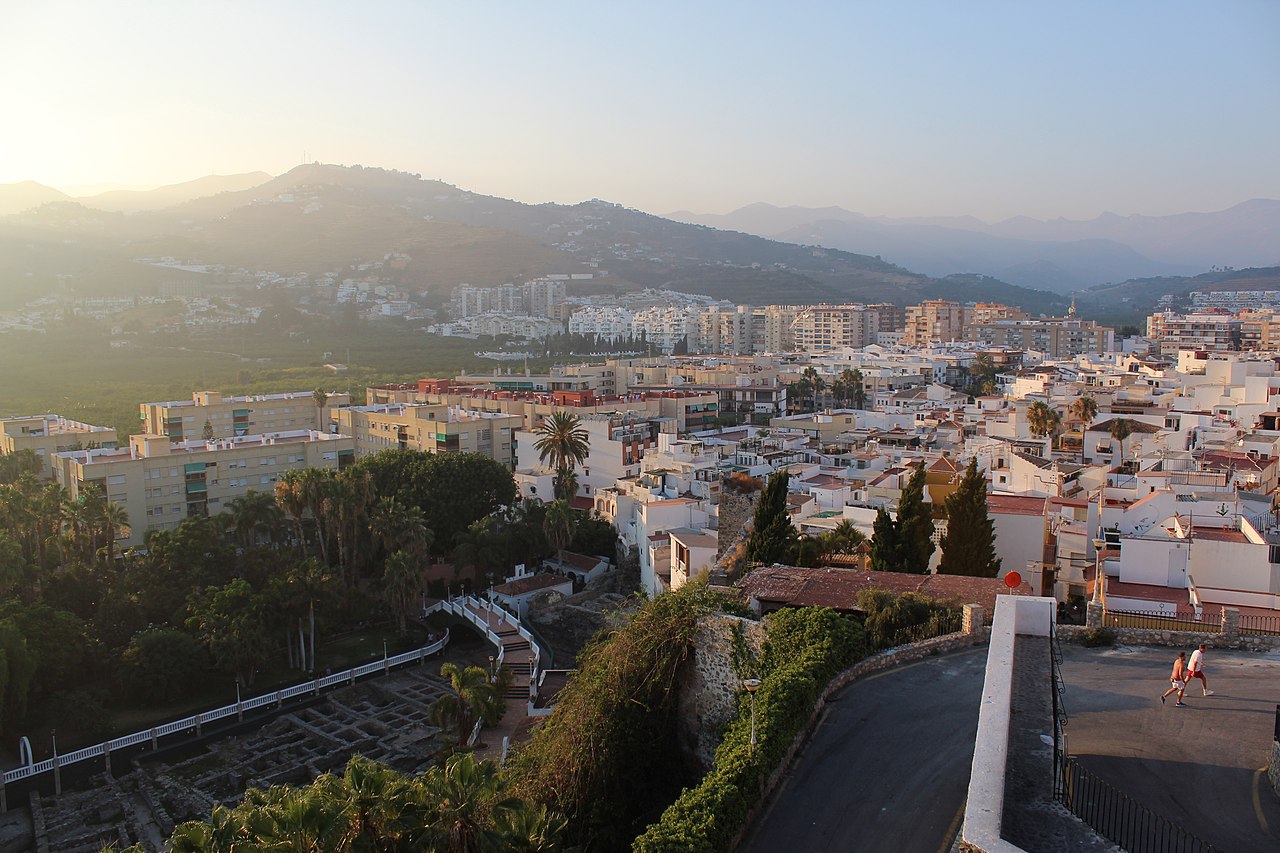
Major evidence of the fish salting and curing industry was uncovered during excavations in the 1970s and 1980s in the extensive Majuelo Botanical Gardens. These revealed the great extent of the rebuilding and modernising of the industry under Roman influence. A segment of the site has been carefully conserved, giving some idea of the size of the industry. This industry required not only large quantities of fish and sea salt, produced in many places along the coast, but also a constant supply of fresh running water.
To meet this demand the Romans built in the 1st century AD four miles of water conduit in the valleys of the Rio Seco and the Rio Verde, including five significant aqueducts. All, remarkably, are still standing and four of them are still in use after 2,000 years – adapted by the Moors over the centuries to serve the needs of crop irrigation. The Roman water supply also served the town and recent excavations in the town centre have uncovered the fifth aqueduct and the Roman baths.
The Romans were probably the first to fortify the Castle of Saint Miguel, although frequent rebuilding has obliterated most of the very extensive Roman fortifications. These included a bridge from the castle to the 'Peñon del Santo' with a massive 100 foot (30 m) high arch that survived until at least 1800.
Just below the castle on the landward side is the 'Cueva de Siete Palacios', which translates as 'Cave of the Seven Palaces'. However, it is not actually a cave, rather it is the largest remnant of a Roman palace yet found in Almuñécar, having survived for hundreds of years as 'social housing' until the 'cave dwellers' were re-housed in the 1970s. Only then did its true origins become apparent. It now houses the town museum.
Other important Roman remains in the district include a Roman bridge at Cotobro and Roman tombs in several locations.
Middle Ages:
Visigoths:
With the decline of the Western Roman Empire in the 5th century, Germanic peoples, including the Visigoths, crossed the Pyrenees mountain range into the Iberian peninsula. By 456 the Visigoths emerged as the dominant power, and expanded their territory onto the southwestern Mediterranean coast. However, Hispania remained relatively Romanized under their rule. The Visigoths adopted Roman culture and language, and maintained many of the old Roman institutions, although much of the economic structure collapsed, and at Almuñécar the fish curing industry declined rapidly. The Catholic bishops were the rivals of Visigothic power and culture until the end of the 6th and beginning of the 7th century—the period of transition from Arianism to Catholicism in the Visigothic kingdom.
Muslims:
In 755 Umayyad Abd ar-Rahman I of Damascus, the founder of the Emirate of Cordoba, arrived from North Africa to establish his kingdom. The castle remained the stronghold of the city and the seat of government and its walls were strengthened. Extensive dungeons were built for those out of favour with local rulers, but also baths for the use of the social elite during the al-Andalus centuries.
The cross on Peñon del Santo, the rock at the old harbour entrance, marks the defeat of the Arabs, their surrender at Almuñécar, and the annexation to the Kingdom of Castille in 1489. The Arabic name المُنَكَّب (al-Munakkab, surrounded by mountains) gave origin to present-day Almuñécar.
Modern Era and Present:
Following the restoration of Christian rule, new architectural statements were made – for example the construction of a new church was started in 1557 and completed to the latest design in 1600, the first Baroque-style church in the province of Granada. The old town was also Christianised (or perhaps paganised – by the Goddess of fertility herself), as in the building of the water fountain on the Calle Real (Royal Street), dated to 1559 and with the royal cypher above, but at that time using the existing Roman water supply from Las Angosturas first installed 1500 years earlier.
In 1562, a Spanish fleet sank in a storm in La Herradura Bay.
In 1563, Ottoman corsair Turgut Reis landed at the shores of the province of Granada and captured the coastal settlements in the area, including Almuñécar, along with 4,000 prisoners.
The castle was again extensively rebuilt and placed under the patronage of San Miguel. It was rebuilt and heavily fortified by the Christian King Charles III and last defended (by the French) in the Napoleonic Wars. Just one tower was partly destroyed but also most of the internal buildings. This was the work of the crew of the British vessel, HMS Hyacinth, acting in collaboration with Spanish partisans from Nerja on 27 May 1812. They caused the French garrison to flee and then attempted to render the castle unusable but with little success – owing to the gunpowder being damp. However, the Castle was finished as a military stronghold and following a cholera outbreak in 1830 the castle became the town cemetery, from which use it was cleared in 1986, to permit the restoration which is still in progress.
At the beginning of the Spanish Civil War Almuñécar was where English poet and author Laurie Lee was rescued by the Royal Navy in the summer of 1936. The story is featured in his book, As I Walked Out One Midsummer Morning. In earlier editions the town is referred to as "Castillo" to disguise people's identities.
The town's economy benefited from the raise of national and international tourism since the 1970s as well as neighbour Motril.
Monuments
There's no information in this section yet. The village's profile can complete it from the panel.
What to visit
Fiestas:
Dentro de las festividades que se celebran en el municipio sexitano destacan, cronológicamente, las fiestas del barrio de San Sebastián en honor a su patrón, que tienen lugar el 20 de enero. En La Herradura se festeja el día de San José, el 19 de marzo.
En primavera destaca la Semana Santa de Almuñécar, declarada de interés turístico-cultural, así como las Cruces de Mayo el día 3, festividad muy común en localidades de toda la provincia. Una semana más tarde tiene lugar en la pedanía de El Cerval una romería en honor a su patrona, la Virgen de Fátima, el 13 de mayo. También el domingo más cercano al 15 de mayo se celebra en Almuñécar otra romería, esta vez con motivo de la festividad de San Isidro Labrador, patrón de los agricultores. Finalmente, a primeros de junio se festeja el Corpus Christi.
En verano tienen lugar las principales fiestas y verbenas del municipio, entre las que destacan la noche y día de San Juan, el 23 y 24 de junio, con hogueras en las playas; las de Taramay el primer fin de semana de julio; las del barrio de Los Marinos en honor de la Virgen del Carmen, patrona de los marineros, el 16 de julio; y las fiestas patronales de la Virgen de la Antigua, patrona de la ciudad, del 9 al 15 de agosto.
Por último, en otoño se celebran las fiestas en honor de San Miguel, patrón del barrio homónimo, el 29 de septiembre; las de la Virgen Madre del núcleo de Torrecuevas, el 12 de octubre; y las fiestas del barrio de la Carrera de la Concepción en honor a la Inmaculada, el 8 de diciembre.
Gastronomía:
En el patrimonio gastronómico local destacan especialidades influidas por las costumbres de los antiguos habitantes de Almuñécar y adaptadas a los cultivos predominantes en la zona. Entre otras destacan: la cazuela mohína, de origen mozárabe, con predominio de la almendra cultivada en las zonas altas de las colinas, canela, matalahúga y almíbar. La torta de al-Hajú, de origen hispano-árabe, que contiene principalmente almendras además de miel, clavo, ralladura de limón, miga de pan contenidos entre obleas, evitando así la manteca de cerdo presente en hojaldres. Y el merengazo, típico de la gastronomía sefardí, que está compuesto de una masa a base de almendra, una capa de crema pastelera y coronado por un merengue en forma de ese.
Deporte:
En Almuñécar existen varios equipos de fútbol, entre los que destacan el Almuñécar CF, el CD Almuñécar 2021, el CD Almuñécar City, el CD La Herradura 2005 y la UD Los Marinos.
Gallery




Festivals
September 2026
Festivals this month
- 29 · September Fiestas del Barrio de San Miguel 📆 Add to my calendar
Rest of the year
- March: Semana Santa (25)
- July: Fiestas Barrio Los Marinos (16)
- August: Virgen de la Antigua (15) · Fiestas de Ntra. Sra. de la Antigua Coronada
- December: Navidad en Almuñécar
What's on
Street market
Mercadillo semanal: Viernes, de 09:00 a 14:00 · Av. Fenicia, 18690 Almuñécar, Granada
Gastronomy
There's no information in this section yet. The village's profile can complete it from the panel.
Trails and hiking
•Antiguo Camino de Guerra - Ventorro de la Estaca (11 km)
•Senda del Mediterraneo (GR 92 E-12)
Services
Do you have a business in Almuñécar? Advertise it for free and go premium whenever you like. List my business for free
Famous people
•Carlos Rodríguez Cano, ciclista español
•Francisco Bonet Serrano, futbolista español
•Pablo González Juárez, futbolista español
•José Andrés Rodríguez Gaitán, futbolista español
•Irene Espínola Pérez, balonmanista española
•Francisco Rodríguez Gaitán, futbolista español
Town hall
Alcaldía: Trinidad Herrera Lorente
Web oficial: http://www.almunecar.es/
Town hall of Almuñécar
Alcaldía: Trinidad Herrera Lorente Web oficial: http://www.almunecar.es/
Here goes your town hall's profile or your website address. Are you from the town hall? Go premium to complete your profile and edit your village's content. hola@ciudadesypueblos.es
How to get there
- 🚗 62 km from Granada (about 44 min by car)
- 🚗 81 km from Málaga (about 57 min by car)
🧭 Travelling around the villages of Spain: a practical guide — Opening hours, transport, money and customs, before you set off.
- ✈️ 64 km from Granada-Jaén airport (about 45 min by car)
- ✈️ 90 km from Málaga-Costa del Sol airport (about 64 min by car)
Practical info
🅿️ Where to park
- Where to park · 0.2 km away
- Where to park · 0.3 km away
- Where to park · 0.3 km away
🏧 Nearest cash machine
- ATM · 0 km away
- BBVA · 0.2 km away
- Caixabank · 0.2 km away
⛽ Nearest petrol station
- Estación de Servicio La Paloma · 0.5 km away
- Estación de Servicio BP Essa · 0.7 km away
- Estación de Servicio Moeve La Herradura · 4.3 km away
ℹ️ Tourist office
- Tourist office · 0.3 km away
- Oficina de turismo · 0.5 km away
- Tourist office · 1.7 km away
🔭 Viewpoints
- Viewpoints · 0.7 km away
- Viewpoints · 1.2 km away
- Viewpoints · 1.6 km away
🏖️ Where to swim
- Playa Puerta del Mar · 0.5 km away
- Playa de San Cristóbal · 0.8 km away
- Costa Banana Pool · 0.8 km away
Buses
Check the route, times and public transport connections to Almuñécar:
Pharmacy and health
Sanidad:
El municipio cuenta con un centro de salud —con servicio de urgencias— en la calle Chingeti s/n, y con cuatro consultorios médicos de atención primaria situados uno en la calle Cueva Siete Palacios n.º 7; otro en la carretera Centro Cultural los Marinos s/n; otro en la calle Gonzalo Barbero n.º 18, de La Herradura; y el otro en la carretera de Jete s/n, de Torrecuevas, dependientes todos ellos del Área de Gestión Sanitaria Sur de Granada. El área hospitalaria de referencia es el Hospital Santa Ana de Motril.
Transportes y comunicaciones:
Almuñécar cuenta con una red de autobuses urbanos en régimen de concesión por la empresa Grupo Fajardo Autocares. Las líneas se dividen en horarios de invierno —desde 16 septiembre a 30 de junio— y horarios de verano —desde 1 de julio hasta el 15 de septiembre—. El horario de verano se compone de las siguientes líneas:
Los horarios de invierno se componen de estas líneas:
Wall and news
Log in with your profile to post. Posting on the walls is free.
This wall is still quiet.
Obituaries
There are no obituaries published right now in Almuñécar.
In loving memory
There are no memorials in Almuñécar yet.
Videos
Discover Almuñécar on video: