
Olivenza
Badajoz · Extremadura
Olivenza (Spanish: [oliˈβenθa] ) or Olivença (Portuguese: [oliˈvẽsɐ] ) is a town in southwestern Spain, close to the Portugal–Spain border. It is a municipality belonging to the province of Badajoz, and to the wider autonomous community of Extremadura. The town of Olivença was under Portuguese sovereignty from 1297 (Treaty of Alcañices) to 1801, when it was occupied by Spain during the War of the Oranges and ceded that year under the Treaty of Badajoz. Spain has since administered the territory (now split into two municipalities, Olivenza and Táliga), whereas Portugal invokes the self-revocation of the Treaty of Badajoz, plus the Congress of Vienna of 1815, to claim the return of the territory. In spite of the territorial dispute between Portugal and Spain, the issue has not been a sensitive matter in the relations between these two countries. Olivenza and other neighbouring Spanish (La Codosera, Alburquerque and Badajoz) and Portuguese (Arronches, Campo Maior, Estremoz, Portalegre and Elvas) towns reached an agreement in 2008 to create a euroregion.
Sections the premium town hall can edit · Fixed sections of the guide
Origins
There's no information in this section yet. The village's profile can complete it from the panel.
History
Medieval and early modern history:
It is possible the settlement did not exist during the Muslim period. A 1278 document refers to the place as 'populated again', but this is not conclusive. Badajoz and its surrounding territory (including the lands around Olivenza) were conquered by Alfonso IX of León in 1230. Taken away from the alfoz of Badajoz, the Knights Templar had occupied the territory already by 1258, founding an encomienda in Olivenza integrated in the Bailiwick of Jerez de los Caballeros. They proceeded to build a castle and a church as core of the hamlet, following the templar model of repopulation.
The second half of the 13th century saw continual territorial disputes between the Order of the Temple and the council of Badajoz over the lands north of the Fragamuñoz creek, and the municipal militias of Badajoz invaded Cheles, Alconchel and Barcarrota in 1272, although those territories were retroceded to the Order by means of a 1277 settlement. Soon later, by 1278, Alfonso X recognised the jurisdiction of the Council of Badajoz and the Diocese over Olivenza, putting an end to the Templar control over the hamlet. Amid a situation of unrest in the Crown of Castile in the wake of the death of King Sancho IV, King Dinis of Portugal forced King Ferdinand IV to sign the Treaty of Alcañices in 1297 and cede, amongst other possessions, Olivenza to the Kingdom of Portugal. On 4 January 1298, Dinis granted Olivenza a foral (charter) similar to that of Elvas.
1510 – King Manuel I of Portugal renews the town charter and orders the building of fortifications and the Olivenza Bridge over the Guadiana River (Ponte de Olivenza, later known as Ponte de Nossa Senhora da Ajuda (Our Lady of Help Bridge) or, simply as Ajuda bridge), on the road to Elvas. Construction of Santa Maria Madalena Church begins. This church would be the residence of the Bishop of Ceuta for many years.
Following the start of the war between Castile and Portugal in 1640 (variously known as Secession, Aclamation, Restoration or Portuguese Independence War), Olivenza was taken in 1657 by forces loyal to the Spanish Monarchy led by Neapolitan governor Francesco Tuttavilla, Duke of San Germán after a long siege. By means of the 1668 Treaty of Lisbon, Olivenza was returned to the Kingdom of Portugal.
In the context of the War of the Spanish Succession, the Ajuda Bridge was used for the retreat of the Anglo-Portuguese army after they were crushed at the Battle of La Gudiña in May 1709. The victorious Spanish Bourbon army led by the Marquis de Bay ordered its destruction to prevent the Portuguese using it again.
19th century:
In the wake of the Portuguese refusal to enter an alliance with France and Spain against Britain, the brief War of the Oranges began in 1801, with the French troops marching on Portugal, then followed by Spanish troops. Olivenza capitulated to the Spanish army led by Godoy on 20 May 1801. The 1801 Treaty of Badajoz putting an end to the war returned to Portugal the occupied towns except those on the left bank of the Guadiana river (the territory of Olivenza), which were ceded to Spain, including its inhabitants, on a 'perpetual' basis. The Treaty also stipulated that the breach of any of its articles would lead to its cancellation.
1801
29 January 1801 – Treaty of Badajoz is signed between France, Spain and Portugal. If Portugal does not comply with the terms, it would give Spain and France a reason for invasion.
20 May 1801 – Spanish troops enter Portugal alongside the French, effectively invading Portuguese border towns after Portugal does not comply with the terms of the Treaty of Badajoz.
6 June 1801 – Portugal, Spain and France sign the Treaty of Badajoz, in which Olivenza is given to Spain.
1805
26 January 1805 – The Portuguese currency is forbidden.
20 February 1805 – Teaching in Portuguese is forbidden.
14 August 1805 – Adoption of the Spanish language in city hall documents.
1807
October – Treaty of Fontainebleau (1807) between Spain and France dividing Portugal and all Portuguese dominions between them.
November – French and Spanish troops again march over Portugal, in the Peninsular War.
1808
John, Prince Regent of Portugal, repudiates the Treaty of Badajoz claiming that the ongoing war abrogated the peace terms of the treaty.
1809
July – Portugal presents to the Supreme Central Junta, in Seville, an official order of restitution of the territory of Olivenza.
1810
19 February 1810 – Treaty of alliance and friendship between Portugal and Britain, whereby the United Kingdom pledges to help Portugal to regain possession of Olivenza, in turn receiving the exploration of the Portuguese establishments of Bissau and Cacheu for a period of 50 years.
Portugal starts negotiating a treaty with the Regency Council of Spain, whereby Olivenza should be given back to Portugal.
1811
March – French general Soult takes Olivenza.
15 April 1811 – Beresford, a British marshal serving as Commander-in-chief of the Portuguese Army, briefly retakes Olivenza.
1813
19 May 1813 – The remaining Portuguese language private schools are closed by the Spanish authorities.
1814
30 May 1814 – The Treaty of Paris between France and Portugal includes a provision declaring the 1801 treaties of Badajoz and Madrid null and void. Spain is not a part of this agreement.
1815
9 June 1815 – The Portuguese delegation to the Congress of Vienna, led by Pedro de Sousa Holstein, succeeds in including article 105 in the Final Act (aka the Treaty of Vienna), stating that the winning countries are to "endeavour with the mightiest conciliatory effort to return Olivenza to Portuguese authority". The Spanish representative to the Congress, Pedro Gomes Labrador, refuses to sign the Treaty, registering a protest against several of the Congress resolutions, including article 105.
27 October 1815 – Expecting the quick restitution of Olivenza, Prince Regent John nominates José Luiz de Sousa as plenipotentiary.
1817
29 January 1817 – Portugal occupies Uruguay due to rebel threats against Brasil.
7 May 1817 – Spain finally ratifies the Treaty of Vienna.
1818–1819 – Spain and Portugal, with the mediation of France, the United Kingdom, Russia and Austria, negotiate in the Conference of Paris toward a peaceful restitution of Uruguay to Spain. Spain accepts the terms of an agreement proposed by the mediators but due to internal problems and the Liberal Revolution in 1820, actions never took place.
7 November 1820 – Spanish authorities forbade the use of private teaching in Portuguese.
1821 – Portugal annexes Uruguay. In reaction, Spain withdraws from the Olivenza talks.
1840 – The Portuguese language is forbidden in the territory of Olivenza, including inside churches.
1850 – The village of Táliga is separated to form its own municipality.
1858 – Isabel II of Spain grants the title of City (Ciudad) to Olivenza.
29 September 1864 – The Treaty of Lisbon (1864) between Portugal and Spain is signed, demarcating the border from the estuary of the Minho river, on the far North, to the confluence of the Caya River with the Guadiana river, just north of Olivenza. The demarcation of the border is not pursued further because of the situation of Olivenza.
20th century:
1918/1919 – With the end of World War I, the Portuguese government studies the possibility of taking the situation of Olivenza to the Paris Peace Conference. However, as Spain had not participated in the War, the intervention of the international community in this issue is not possible.
29 June 1926 – Portugal and Spain sign the Convention of Limits (1926) an agreement demarcating the border from the confluence of Ribeira de Cuncos with the Guadiana, just south of Olivenza, to the estuary of the Guadiana, on the far South. The border between Portugal and Spain from the confluence of the Caya river to the confluence of the Cuncos is not demarcated and remains so nowadays, with the Guadiana being the de facto border.
1936–1939 – During the Spanish Civil War, Portu
Monuments
Iglesias parroquiales católicas bajo las advocaciones de Santa María Magdalena y de Santa María del Castillo, en la archidiócesis de Mérida-Badajoz.
Ciudadela Medieval y Alcázar.
Iglesia de Santa María del Castillo.
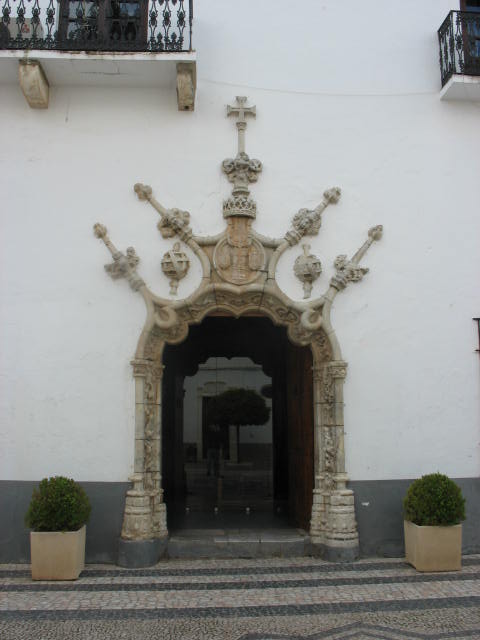
Fachada de las Casas Consistoriales, con portada en estilo manuelino.
Iglesia parroquial de la Magdalena.
Santa Casa de la Misericordia.
Convento de Clarisas o San Juan de Dios.
Fortificaciones abaluartadas.
Puerta del Calvario.
puente de Ajuda.
Plaza de Toros de Olivenza.
Valdecebadar (San Francisco de Olivenza).
Castillo:
El castillo fue levantado por la Orden del Temple a la que Alfonso IX de León cedió la aldea como pago por su ayuda en la conquista de la Taifa de Badajoz. Tras pasar a manos portuguesas, don Dinís lo amuralló en 1298. El alcázar o castillo de Olivenza conserva gruesas murallas del siglo XIV, sin almenas. Las torres conservan sus matacanes. La torre del homenaje, construida en el reinado de Alfonso IV de Portugal, hijo de Dionisio I, y reforzada en 1488 por orden de Juan II de Portugal llegando a ser la más alta de Portugal, midiendo 36 m de altura y 18 m de lado y tiene tres pisos, de los que destaca la decoración del último. Se accede a ella por diecisiete rampas con cubierta de bóveda.
La puerta de Alconchel y la puerta de los Ángeles están enmarcadas por dos torreones circulares y presentan un vano de medio punto abovedado, sin aparecer elementos decorativos. Está protegido por el decreto de 22 de abril de 1949 y la Ley 16/1985 sobre el Patrimonio Histórico Español. Cierran la ciudadela medieval las puertas de la Gracia y la de San Sebastián, reconstruida en 2006.
A día de hoy engloba y acoge el Museo Etnográfico González Santana, llamado así en honor de su creador Francisco González Santana. Acoge una espectacular recreación de diferentes actividades de la vida en la comarca de Olivenza en los primeros años del siglo XX.
What to visit
Lengua portuguesa:
A finales del siglo XIX los habitantes de Olivenza eran bilingües, según Leite de Vasconcelos. En las aldeas aledañas, sin embargo, utilizaban únicamente el portugués para comunicarse. En la década de 1960 las aldeas se habían convertido ya en bilingües.
La ciudad fue, hasta la década de 1940, de mayoría lusohablante (portugués oliventino). Sin embargo, la generación de la época empezó a enseñar a sus hijos a hablar en español. A principios del siglo XXI, el portugués oliventino ha desaparecido prácticamente excepto entre personas nacidas antes de la década de 1950.
Medios de comunicación:
Prensa escrita
El municipio cuenta con su propio periódico local, Hoy Olivenza, formado a partir de una corresponsalía del diario regional Hoy Diario de Extremadura.
Televisión
Olivenza cuenta desde 1992 con una cadena de televisión, TVO, que emite semanalmente un boletín informativo sobre la ciudad. Asimismo, su emisión tiene por costumbre comenzar los jueves y repetirse diariamente hasta el miércoles, día en el que no se emite.
En la actualidad, la emisión de TVO se encuentra suspendida.
Gallery




Festivals
September 2026
Festivals this month
- No festivals recorded this month.
Rest of the year
- January: Fiestas patronales de San Antón (9)
- February: Carnaval (20)
- March: Feria del Toro (3)
- June: Muñecas de San Juan (23) · Feria de la Farrapa y Fiestas de Olivenza
- August: Fiestas del Emigrante (5) · Ferias y Fiestas (15)
- November: Feria Medieval (11)
What's on
Street market
Find the day and place of the local street market:
Gastronomy
There's no information in this section yet. The village's profile can complete it from the panel.
Trails and hiking
There's no information in this section yet. The village's profile can complete it from the panel.
Services
Do you have a business in Olivenza? Advertise it for free and go premium whenever you like. List my business for free
Famous people
•Paulo da Gama, explorador portugués
•Guillermo Fernández Vara, político español
•Jesús Carrasco, escritor y novelista español
•Jesús Perera, futbolista español
•Pedro de Fonseca, cardenal español
•Consuelo Rodríguez Píriz, política española
Town hall
El actual alcalde es Manuel José González Andrade (PSOE).
Town hall of Olivenza
El actual alcalde es Manuel José González Andrade (PSOE).
Here goes your town hall's profile or your website address. Are you from the town hall? Go premium to complete your profile and edit your village's content. hola@ciudadesypueblos.es
How to get there
- 🚗 30 km from Badajoz (about 21 min by car)
- 🚗 217 km from Sevilla (about 153 min by car)
🧭 Travelling around the villages of Spain: a practical guide — Opening hours, transport, money and customs, before you set off.
- ✈️ 42 km from Badajoz airport (about 30 min by car)
- ✈️ 220 km from Sevilla airport (about 155 min by car)
Practical info
🅿️ Where to park
- Where to park · 0 km away
- Where to park · 0.2 km away
- Where to park · 0.4 km away
🏧 Nearest cash machine
- Unicaja Banco · 0.4 km away
⛽ Nearest petrol station
- Repsol · 0.6 km away
- Estación de Servicio Gasoal · 0.6 km away
- M&D Olivenza · 1 km away
ℹ️ Tourist office
- Centro de Recepción de Visitantes del Parque Temático Natural Alqueva · 0.3 km away
- Oficina Municipal de Turismo · 0.4 km away
Buses
Check the route, times and public transport connections to Olivenza:
Pharmacy and health
Find the nearest pharmacy and health centre, with the address and how to get there:
Wall and news
Log in with your profile to post. Posting on the walls is free.
This wall is still quiet.
Obituaries
There are no obituaries published right now in Olivenza.
In loving memory
There are no memorials in Olivenza yet.
Videos
Discover Olivenza on video: