Íllora
Granada · Andalucía
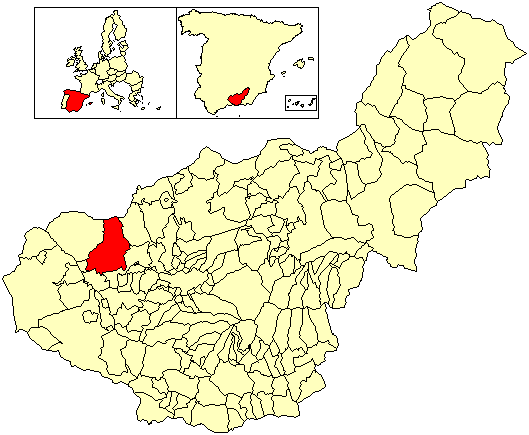
Íllora is a municipality in the province of Granada, located in Andalucia. Spain. It is surrounded by the following villages: Moclín, Pinos Puente, Valderrubio, Moraleda de Zafayona, Villanueva Mesía, Montefrío, and with the municipality of Alcalá la Real. The municipality consists of Íllora, Alomartes, Tocón, Escóznar, Obéilar- also known as La Estación de Íllora–, Brácana, Ventas de Algarra, Vallequemado and La Alhondiguilla. The main source of income is the rural economy, especially the olives.
Sections the premium town hall can edit · Fixed sections of the guide
Origins
La forma actual Íllora proviene del antiguo topónimo registrado "Illurco" o "Ilurco" que, según Guillermo de Humboldt, parece de origen vasco o de alguna hipotética lengua pirenaica emparentada con él, anterior a la presencia de lo ibérico y lo celta; si bien hoy en día casi ningún filólogo defendería la presencia de una lengua pirenaica tan al sur de la península. De este antiguo topónimo sí que proviene su gentilicio, "ilurquense".
Cabe destacar que todas las referencias históricas desde el siglo XV hasta el siglo XIX, mostraban la palabra "Yllora", escrita con Y en lugar de con I.
History
Some archaeological discoveries have been found in Íllora belonging to the prehistory, the Neolithic and mainly of the Copper Age. Towards the year 600 BC the Carthaginians landed in the Iberian Peninsula imposing their authority on the Phoenicians and, with a clever policy, consolidate the foundations of their empire, including Illurco.
With the arrival of the Romans the colonies settle in already existing villages. Of them, Plinio points out among the most celebrated of the interior to Illurco.
During the Muslim conquest there are few data on Íllora; nevertheless, it is deduced from the Christian chronicles that it must have been an important town with fortress and suburbs. Precisely in June 1319 infants Pedro and Juan of Castille seized the town of Íllora and its suburb when they went to devastate the Vega de Granada, and according to the Alfonso XI, if they had stayed another day they would also have taken his castle, although the infante Pedro did not want to stay there any longer, because his will was to besiege Granada and keep it surrounded «until they win it, or die on it», as recorded in the Grand Chronicle of the same king, although shortly after both infants died in the Disaster of the Fertile valley of Granada, happened the 25 of June 1319.
In June 1319, when the Vega de Granada was being devastated, the town of Íllora came into the possession of the infantes Pedro and Juan de Castilla. If they would have stayed one more day, affirms the Chronicle of Alfonso XI, they would have also taken its castle. The infante Pedro did not want to stay anymore, as his main ambition was to isolate Granada until they seized it. However, both infantes were killed in the valley of Granada disaster, which occurred 25 June 1319.
In the spring of 1486 King Ferdinand of Aragon resumed the war against Granada beginning with the place of the current Loja, whose surrender of the city was the key that would open the conquest of the fortress of Ilurquense. On June 8 of that same year the Catholic Monarchs conquered Íllora, who later named Gonzalo Fernández de Córdoba the Great Captain, as their first Christian warden, hence the name of the local school.
After the Reconquest, the manors did not reach similar dimensions to those of other areas of the country. Although they played an important role in the beginning of the new period, little by little it was disintegrating and losing presence in the configuration of the town. The access to the property was produced by the abandonment of the original Muslim owners, passing into Christian hands. Economically, this period will be based on subsistence agriculture, with wheat and barley constituting the population's food base.
During the first half of the nineteenth century Íllora will live a stage of stability that will be interrupted by the Napoleonic invasion and the subsequent War of Independence. The French provoked the rejection of the people, who supported the Grenadian uprising against Godoy in April, and even enlisted many people as soldiers against the French takeover of Granada. The region was in a situation of decadence due to the looting that the Napoleonic troops carried out.
With the return of King Fernando VII Íllora regained its economic and social impulse to be again altered negatively with the clashes between absolutists and realists, who will have in the passage of the General called Rafael Riego Montefrío and its support for certain sectors of the population of Íllora its contact element to subsequently suffer repression in the area. Before the uprising of Loja, the ilurquenses remained faithful to the authorities and even collaborated with the Army to capture fugitives from that city. Circumstance that will not be repeated in the democratic six-year term when Íllora will be added to it.
Monuments
There's no information in this section yet. The village's profile can complete it from the panel.
What to visit
Patrimonio:
En el centro del pueblo, en lo alto de una peña, se encuentran las ruinas del antiguo castillo de Íllora, aunque de él apenas se conservan algunos restos de las murallas. Dicho castillo data del periodo califal (siglos IX-X) y está estructurado en tres recintos: la villa, la alcazaba y el arrabal. En 2010 empezaron las obras de restauración y reconstrucción del castillo y actualmente se puede hacer visitas visitas guiadas por el recinto.
Asociadas a ese castillo, existen una serie de atalayas o torres de vigilancia, entre las que sobresale la Torre de Brácana. En Tocón, hay otra torre, en este caso de una alquería o castillo rural. Todas ellas son obras de época nazarí.
Íllora cuenta con otro monumento histórico-artístico, catalogado como Bien de Interés Cultural desde 1980: la Iglesia de Santa María de la Encarnación, proyectada por Diego de Siloé, constructor de entre otras la Catedral de Granada, durante (1542-1573) en el siglo XVI con la intervención de su discípulo Juan de Maeda y Diego de Pesquera entre otros maestros.
Museos:
Pósito del Trigo: de estilo neoclásico, fue construido en 1738.
Molino - Museo de Alomartes.
Fiestas:
Las fiestas en honor a San Rogelio tienen lugar el tercer fin de semana de agosto. Sin embargo, el día del patrón de Íllora es el 16 de septiembre, que también es festivo local.
La Feria del Ganado es el segundo fin de semana de octubre, y en su día estaba considerada como una de las ferias más relevantes de toda España.
La Semana Santa de Íllora es uno de los más importantes acontecimientos que se produce cada año desde el punto de vista religioso y cultural, celebrándose en la semana del primer plenilunio de la primavera. Comenzando con su pregón, desde el Domingo de Ramos hasta el Domingo de Resurrección se suceden multitud de actos y celebraciones programadas por la Parroquia de la Encarnación y las cuatro hermandades existentes: la Patronal de San Rogelio, la del Cristo de la Juventud, la de Nuestro Padre Jesús Nazareno y María Santísima de los Dolores, y la cofradía del Santísimo Cristo de la Veracruz.
Gastronomía:
En la cocina tradicional de Íllora es importante destacar los métodos de conserva tradicional de los alimentos que ha llegado hasta nuestros días. El mantenimiento de las carnes y de los embutidos en aceite de oliva son la base de los principales guisos de esta gastronomía. Entre estos productos destacan el lomo de orza —plato típico de Granada y de Castilla-La Mancha—, el chorizo y salchichón en aceite y los chicharrones.
Otros platos típicos son los espárragos en miguilla, el choto al ajillo y las gachas de mosto.
Música:
El acontecimiento musical más importante que se celebra en el municipio es el festival Parapanda Folk. Está declarado Festival Turístico Nacional. Tiene lugar durante la última semana de julio, y en él actúan grupos de música étnica tanto nacionales como internacionales. Esta actividad está considerada de gran relevancia cultural.
Deporte:
La Unión Deportiva de Íllora (UD Íllora) es el principal equipo de fútbol que tiene el municipio. Su campo se encuentra en el Complejo Deportivo La Laguna. Desde 2011 el Campo de Fútbol Antonio García "El Calvo" es de césped artificial de 2 estrellas (lo máximo de la FIFA son 5).
Las categorías inferiores de ese equipo se denominan UD Parapanda. También hay equipos de fútbol sala, cuyo campo es el pabellón municipal de Íllora.
Gallery




Festivals
September 2026
Festivals this month
- No festivals recorded this month.
Rest of the year
- August: San Rogelio (18)
What's on
Street market
Find the day and place of the local street market:
Gastronomy
There's no information in this section yet. The village's profile can complete it from the panel.
Trails and hiking
•Ramos - Morrón (PR-A 248, 9.9 km)
Services
Do you have a business in Íllora? Advertise it for free and go premium whenever you like. List my business for free
Famous people
•José Eduardo González Navas, político español
•Juan Bautista Sánchez, militar español
•Juan Ramos Camarero, político español
•Nicolás Jiménez Molina, político español
•Rogelio, santo
Town hall
Gobierno municipal:
Evolución de la deuda viva municipal:
El concepto de deuda viva contempla sólo las deudas con cajas y bancos relativas a créditos financieros, valores de renta fija y préstamos o créditos transferidos a terceros, excluyéndose, por tanto, la deuda comercial.
Town hall of Íllora
Gobierno municipal: Evolución de la deuda viva municipal: El concepto de deuda viva contempla sólo las deudas con cajas y bancos relativas a créditos financieros, valores de renta fija y préstamos o créditos transferidos a terceros, excluyéndose, por tanto, la deuda comercial.
Here goes your town hall's profile or your website address. Are you from the town hall? Go premium to complete your profile and edit your village's content. hola@ciudadesypueblos.es
How to get there
- 🚗 35 km from Granada (about 25 min by car)
- 🚗 99 km from Málaga (about 70 min by car)
🧭 Travelling around the villages of Spain: a practical guide — Opening hours, transport, money and customs, before you set off.
- ✈️ 18 km from Granada-Jaén airport (about 13 min by car)
- ✈️ 110 km from Málaga-Costa del Sol airport (about 78 min by car)
Practical info
🅿️ Where to park
- Where to park · 0.4 km away
🏧 Nearest cash machine
- Caixabank · 6.3 km away
- Nearest cash machine · 6.3 km away
- Caja Rural · 7.5 km away
⛽ Nearest petrol station
- Moeve · 1.1 km away
- Galp · 1.3 km away
- E.S. Montes Calvo · 3.4 km away
🔭 Viewpoints
- Viewpoints · 3.2 km away
- Mirador de Cuesta Cambil · 4.1 km away
- Mirador de El Morrón · 4.6 km away
Buses
Por el municipio pasa la línea de AVE a Granada, inaugurada en 2019, que une la ciudad de Granada con Antequera y Madrid. La estación más cercana es la de Loja.
Pharmacy and health
Find the nearest pharmacy and health centre, with the address and how to get there:
Wall and news
Log in with your profile to post. Posting on the walls is free.
This wall is still quiet.
Obituaries
There are no obituaries published right now in Íllora.
In loving memory
There are no memorials in Íllora yet.
Videos
Discover Íllora on video: