Chella
Valencia · Comunidad Valenciana
Chella is a municipality in the comarca of Canal de Navarrés in the Valencian Community, Spain.
Sections the premium town hall can edit · Fixed sections of the guide
Origins
There's no information in this section yet. The village's profile can complete it from the panel.
History
Chella is of great archaeological interest and is well known through various explorations and surveys.
Ceramics and flints have been found showing a long human occupation, from the Mesolithic to the early age of the metal. From the Neolithic, vestiges are also present.
From the Iberian period, there was an abundant ceramic painted geometric decoration and fragments of vases black varnish. Nearby, in a northwestern ravine, two slabs serving as a bridge seem to be vestiges of the threshold of a Roman house.
In the Muslim era, Chella was a farm that James I of Aragon donated to Pere Dovit, although he later returned to the crown. In 1341, the king gave it to Tomás de Ulmis, who passed it in 1356 to the count of Denia and later to the duchy of Gandia. In 1611, Carlos of Borja published a mapping of the population after the expulsion of the Moriscos. Later, it belonged to the Marquis de Bélgida.
Despite the existence of archaeological remains of an Iberian village, located in Los Secanos de Arriba, as well as a Roman farmhouse in the current house of Fulgencio and remains Muslim remains that lived in spaces the caves of Peña del Turco, the current municipality of Chella has its origin in a Muslim farm, located in the current square of the old church, where there is still a part of the wall of the mosque which is currently a niche with the Virgin of Gracia patron saint of the town.
In 1244, James I of Aragon conquered the region and rebelled against Al-Azraq, a Muslim ruler, and against the inhabitants of Chella. After being defeated, they were expelled, repopulating the commune with Muslims loyal to the king. The population was given in stronghold successively to Thomas de Ulmis, the Count of Denia, Pedro Escintelles and the first Duke of Gandia (Alfonso el Vell), and after his death returned to the Crown.
During the Germanías, the Moors of Chella were forced to be baptized and the parish of Bolbaite dismembered from that of Chella.
With Carlos of Borja, he returned to the hands of the dukes of Gandia and the counts of Oliva; and in 1609 Philip III (King of Spain) ordered the expulsion of the Moors and Chella was completely abandoned until 1611. It was then that the letter was granted and the new settlers (Llobregat, Granero, Garcia Esparza, Palop, etc.) were installed.
During this century, the population is growing; the remains of the Muslim castle remain in the upper part, today the district of La Peña. This development is consolidated in the eighteenth century, when the feudal lords are no longer the Borja, but the Marquis de Bélgida. In the war of succession Chella ceases to belong to the government of Xàtiva and enter the village of Montesa with the neighboring municipalities of Anna, Enguera and Estubeny. All these cities were affected by the earthquake of 23 March 1748, which destroyed the old church of Chella, thus accelerating the construction of the new (1763) neoclassical style and Latin cross with bell-shaped corners towards the cardinal points, turn and that it keeps its first bell Maria de Gracia dating from 1789.
During the same century the transformation of dry lands in the orchard, thanks to the discovery of a new source (Le Abrullador) thanks to the examination of Cabanilles has generated significant economic growth.
In the nineteenth century, when territorial lordships disappeared, Chella became a municipality in the municipal sense. In the Madoz census of 1840, the population was 1200 inhabitants, whose economy was based on the cultivation of wheat, corn, barley and the production of oil, wine and silk. During the restoration, the agricultural social structure was made up of small and medium-sized landowners and day laborers, which led to the appearance of "caciquism" (the name given to all the political relations that animated the years of the Restoration of the Bourbons in Spain (1874–1931)).
There is a legend, with romantic hues, that El Chato, a true character in the service of caciquism, became a rodero (bandit) after a disappointment in love.
The phylloxera (destructive vine aphid) has brought about the end of vineyard cultivation and wine production. This caused many emigrations in Argentina or Algeria (Sidi Bel Abbès) and the extension of the olive growing.
Since the time of the Republic and the civil war, stands in the barracks of Paterna, the figure of Carlos Fabra Marin (07/02 / 1904-6 / 7/1970), Republican sergeant who aborted, at night on 29 July, with his aide-de-camp and his only pistol (a 9-millimeter Bergman), the seditious military uprising in Valencia. The shooting left 3 dead and several wounded. This intervention was decisive to avoid the military rebellion of Valencia against the Second Republic. He was decorated for this action by General José Miaja.
Passing captain in 1937, remaining close to general José Miaja and the republican government in Valencia, he decided to send the family (wife, son and daughter) in 1938 to France and joined his family in exile in France on 2 March 1939 and helped many migrant families in the years 1950–1960.
Arrested during the German occupation, he was taken prisoner at the Vernet camp of Ariège in the Pyrenees.
During the dictatorship of Francisco Franco, he was condemned to ostracism by the inhabitants and related political parties, until his heroic history was found through essays and publications. Since then, a street in Chella has been awarded. His direct descendants still live in Chella as well as in France where he died on 6 July 1970 without having seen his native country again. First buried in St-Denis near Paris, his remains were in 1986 repatriated to Chella (paid by the City Council of Valencia), during the commemoration of the 50 years of the end of the Civil War, where a tribute was paid to him by the veterans still alive and many associations.
A tribute to his heroic intervention was delivered by Paterna City Council in 2006.
With the arrival of democracy and the return of emigrants, the economy has improved. The labor force moved out of the agricultural sector into construction and services. Domestic manufacture and the development of caliqueños cigars constituted a submerged economy, which employed mainly women's work.
Currently, urban development continues along the same routes: Higueral, Carlos Fabra, Federico Granero, Blasco Ibáñez, Miguel Hernández, La Paz and Valeriano Bellver streets, and Avenida de Santa the Constitution, which has ceased to be an urban transit because of the hijacking of the road. In the direction of Bolbaite (Bolbait in Catalan), the city has expanded with the industrial zone, articulated around the street of the First May, whose crossings take the name of the rural areas of the term. For a decade, the population has increased with the arrival of people coming mainly from Eastern Europe, Maghreb and Great Britain, which opens a new stage of coexistence.
Monuments
Iglesia parroquial de la Virgen de Gracia, reconstruida en el siglo XVIII, y actualmente la cúpula está siendo investigada por expertos, por la posibilidad de que la restauración de la misma pueda haber sido diseñada por Gaudí.
Ermita de San Nicolás.
Casa señorial de los Condes de Buñol.
Antigua mezquita árabe.
Los Castillets, restos de origen árabe.
Parajes naturales y fuentes:
Ruinas de la fuente y lavadero del mirador del Salto.
El Mirador del Salto con peligro de desprendimiento.
El Salto.
Barranco del Zarzalet donde existe una antigua cueva de guardar ganado y una fuente.
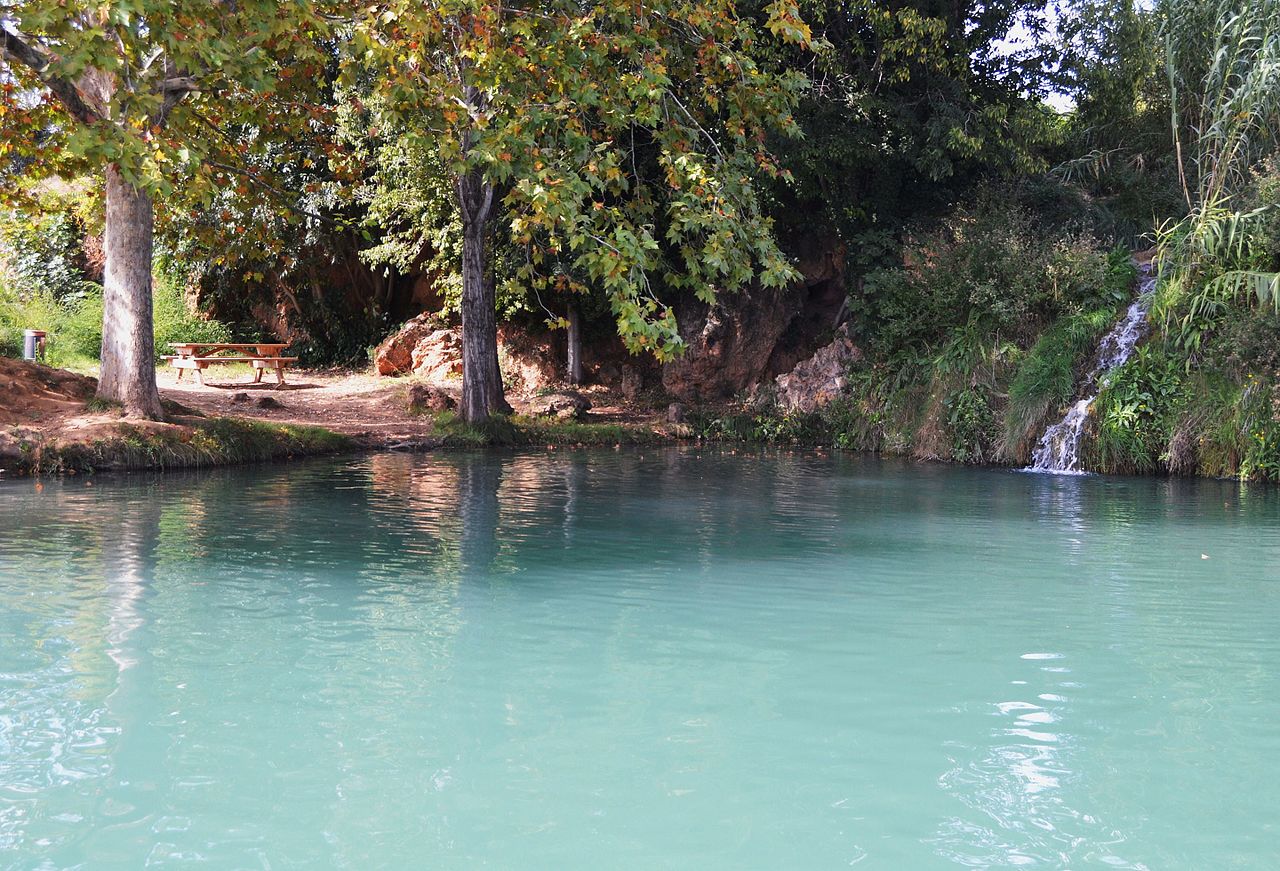
La fuente del Abrullador situada a cinco kilómetros del pueblo, allí se encuentra el manantial que abastece de agua a Chella, siguiendo el cauce que conduce al barranco del Abrullador, se encuentran Los Molinicos y La Playa Salvaje.
Lavadero, en la zona del parque.
La Fuente los Chopos.
Clochicas y El Abogao, son otras fuentes que también se encuentran en el término.
En la parte norte del término quedan todavía los restos de lo que un día fue un balneario de aguas termales y medicinales.
Zonas recreativas:
Parque de la Fuente al lado del río Sellent, un paseo con bancos, zona verde, parque infantil y una parte dedicada a la realización de verbenas, conciertos y actos públicos, servicios.
Parque de la ermita, dotado de zona deportiva para adultos, pista de petanca, zona verde con bancos, fuente y parque infantil.
Parque plaza párroco Don Julio, dotada de bancos con un pequeño parque infantil.
El paseo, ubicado en el centro del pueblo, zona con bancos, dos fuentes y parque infantil.
Instalaciones deportivas:
Pista polivalente del parque de la Fuente, dotada para jugar a futbito y a baloncesto, dispone de vestuarios.
Piscina pública adaptada para personas con movilidad reducida con vestuarios.
Pista de tenis y frontón.
Pista de pádel.
Campo de fútbol de césped artificial con vestuarios.
What to visit
•Fuente Negra
•Mirador del Salto de Chella
•Las Simicas
•Mirador de las Cuevas del Turco
•Teatro al Aire Libre
•Gorgo Catalán
Idioma:
Al igual que otros municipios de la comarca de La Canal de Navarrés, en Chella se habla un dialecto mixto, con rasgos tanto del castellano-aragonés como del valenciano. Estas particularidades lingüísticas fueron recopiladas y analizadas en la obra Ensayo sobre la filología chellina, de José Luis Ponce.
Fiestas:
Fiestas patronales. Celebra sus fiestas patronales en honor de San Blas, los días dos, tres y cuatro de febrero. El primer día de fiestas se celebra la procesión en honor a San Fumat. Dicha procesión comienza de madrugada cuando acaba la verbena y todo el mundo tiene que ir disfrazado y con un caliqueño (puro de la zona)
Fiestas de la Semana Cultural. Se celebran la primera semana de agosto y en ella se hacen concurso de paellas, actuaciones musicales, teatrales, cuentacuentos, concentracionde de djs, campeonatos deportivos, concursos de dibujo, etc.
Fiestas de Moros y Cristianos. El fin de semana después de la semana cultural se hacen los actos de moros y cristianos con la cena-concentración de comparsas el viernes noche y los pasacalles por el pueblo de local en local, el sábado la entrada falsa y el domingo la entrada oficial.
Fallas. Existe una falla en el pueblo y se llama, Falla No - Ni - Na, es una de las fiestas más arraigadas en el pueblo, se fundó en el verano de 1982 y plantó la primera falla en marzo de 1983, se celebran del 15 al 19 de marzo.
Gastronomía:
Especialidad en arroz al horno y arroz caldoso, la casolica de pencas, el puchero y el gazpacho manchego.
Entre los dulces destacan: las torticas de cacahuetes y aceite que se hacen por San Blas, bizcochás, rollicos de anís, pastissets de moniato, pastissets de rosillas, torta en llanda, almendrones, rossegones y por todos los Santos se hacen toñas hogassas.
Gallery




Festivals
September 2026
Festivals this month
- 8 · September Virgen de Gracia 📆 Add to my calendar
Rest of the year
- February: Fiesta patronal: Blas de Sebaste (3) · San Blas (3)
- August: Fiestas de Moros y Cristianos (10)
What's on
Street market
Find the day and place of the local street market:
Gastronomy
There's no information in this section yet. The village's profile can complete it from the panel.
Trails and hiking
There's no information in this section yet. The village's profile can complete it from the panel.
Services
Do you have a business in Chella? Advertise it for free and go premium whenever you like. List my business for free
Famous people
•José Carlos Granero, futbolista español
•Adolf Pizcueta, político español
•Rafael Granero, futbolista español
•Carlos Fabra Marín, militar español
Town hall
Alcaldía: Pablo Seguí Granero
Web oficial: http://www.chella.es
Town hall of Chella
Alcaldía: Pablo Seguí Granero Web oficial: http://www.chella.es
Here goes your town hall's profile or your website address. Are you from the town hall? Go premium to complete your profile and edit your village's content. hola@ciudadesypueblos.es
How to get there
- 🚗 67 km from València (about 47 min by car)
- 🚗 99 km from Alicante/Alacant (about 70 min by car)
🧭 Travelling around the villages of Spain: a practical guide — Opening hours, transport, money and customs, before you set off.
- ✈️ 65 km from Valencia airport (about 46 min by car)
- ✈️ 107 km from Alicante-Elche airport (about 76 min by car)
Practical info
Buses
5 paradas de autobús en el municipio:
•Bolbaite
•Chella, Av. Ronda Blasco Ibáñez 48
•Chella, Av. Constitución 71
•Anna
Pharmacy and health
Find the nearest pharmacy and health centre, with the address and how to get there:
Wall and news
Log in with your profile to post. Posting on the walls is free.
This wall is still quiet.
Obituaries
There are no obituaries published right now in Chella.
In loving memory
There are no memorials in Chella yet.
Videos
Discover Chella on video: