
Arrigorriaga
Vizcaya · País Vasco
Arrigorriaga is a town and municipality located in the province of Bizkaia, in the autonomous community of Basque Country, northern Spain. Arrigorriaga is located 7 km south of Bilbao and is part of Bilbao's metropolitan area. Its official population at the 2019 census was 12,160 inhabitants living on a land area of 16.36 square kilometres (6.32 sq mi). It is conterminous with Bilbao and Basauri in the north, with Ugao-Miraballes and Zeberio in the south, with Zaratamo in the east and with Arrankudiaga and Alonsotegi in the west.
Sections the premium town hall can edit · Fixed sections of the guide
Origins
Arrigorriaga puede significar en euskera 'lugar de piedras rojas' de harri ('piedra'), gorri ('rojo') y el sufijo locativo -aga o también 'lugar de piedras desnudas', ya que gorri es un término polisémico que significa también desnudo, pelado, descarnado.
Existe una conocida leyenda que explica el origen de este nombre como lugar de piedras rojas. Esta leyenda se remonta al menos al siglo XV, ya que fue escrita por primera vez por el cronista vizcaíno Lope García de Salazar en su libro Las Bienandanzas e Fortunas. Según dicha leyenda Arrigorriaga se llamaba antiguamente Padura (marisma en euskera) y fue escenario de la legendaria batalla de Padura que enfrentó a vizcaínos con leoneses. A raíz de dicha batalla, que fue ganada por los vizcaínos, Padura quedó rebautizada como Arrigorriaga, ya que tanta había sido la sangre que se había vertido, que las piedras quedaron teñidas de rojo. La leyenda fue recuperada y utilizada por Sabino Arana en el siglo XIX como instrumento de exaltación de los vascos.
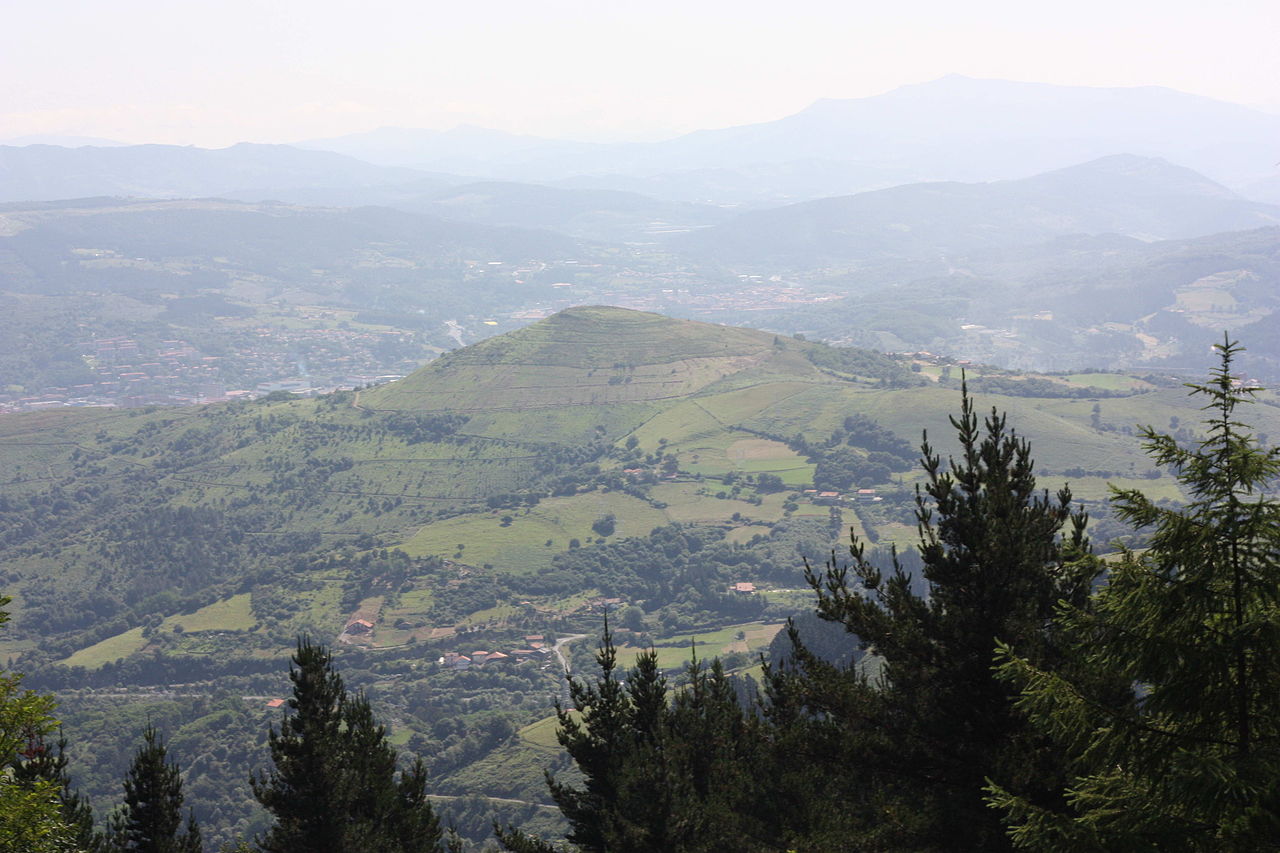
Frente a esta tesis romántica existen otras más prosaicas que afirman que el nombre se debe a las minas de hierro que hubo en la localidad. Según estas tesis el nombre del pueblo pudo deberse a las vetas de mineral de hierro que teñían antiguamente de rojo el monte Ollargan o también a la superficie desprovista de vegetación causada por las explotaciones mineras, lugar de piedras desnudas.
History
Anteiglesia de la Merindad de Uribe, occupied the seat number 39 in the Juntas Generales de Guernica. Until 1876 the Church of Arrigorriaga had great importance in the region, taking on account inside it the municipalities of Arrancudiaga, Basauri, Zarátamo and Alonsótegi. By this year, with the abolition of the jurisdictions and after diverse lawsuits, ended up disengaging. Alonsótegi self constituted as an independent church in the 16th century. Basauri separated from Arrigorriaga in 1510 or, at least, that is the date taken as the most official one, when the parish of San Miguel Arcángel was built, because there does not exist any document to verify that a meeting between two localities' mayors took place that day. Since then, the community was denominated as church of San Miguel of Basauri. The independence of Basauri was unilateral; it didn't have the approval of Arrigorriaga and neither had the permission of the General Juntas of Guernica to take their corresponding seat in them, they didn't manage to achieve it until 1858.
The incoming origins from the legend and the myth, without letting even the name free ("Place of red stones") of this "fable". This legend has many different versions reaffirmed by some and refuted by others. But which is true, is that the myth, legend or story, as you want to call it, of the "Battle of Padura" has produced hundreds of pages in Basque Country's history and literature. The central core of this tale says that by the year 870 or 888 of our age, in that place named Padura (where Arrigorriaga would be located), the armies of the Lord of Biscay, the first according to the history, defeated in a bloody battle the people from León, led by the prince Ordoño, successor to the crown of León and son of the king Alfonso "El Magno". Arrigorriaga would have its origins in the spilt blood that covered the fighting ground.
Other interpretations say that the origin of this term is in the iron veins that could be found in Ollargan mount, and that had given a generic name to the entire municipality. In any case, the first historical news referring to Arrigorriaga are dated in the 12th century, and relate to the incorporation of Arrigorriaga's parish, Santa María Magdalena, to the Monasterio de San Salvador de Oña in 1107 (gathered by the historian Iturriza in his work).
In 1300, mount Ollargan with its iron mines was given to the villa of Bilbao in the town charter granted by D. Diego López de Haro. Few years after, in 1375, the parishioners of this church managed to get from the infant D. Juan, to the Lord of Biscay, the belonging to the jurisdiction of the villa. This measure allowed their inhabitants to be protected from the arbitrariness and abuses of the bigger relatives.
In 1783, led by the mayor José de Arana, the square we know nowadays was inaugurated. In former days, it was located where nowadays Bar padura is located, in front of the town hall. The reason for this placement change was the building of the new Royal Way from Bilbao to Castilla which halved the former public square, preventing, because of its narrowness, the neighbours performing the common unfolding of threshing.
During the two Carlists Wars last century, Arrigorriaga hold some important battles, both occurred at the Moyordín bridge, which linked the town with Zarátamo. The first happened 11 September 1835 and the second, in May 1872.
In 1907, the bridge of Ugertza was built to facilitate communication between Arrigorriaga and the central core. In 1920, the east side of the church, occupied with the old cemetery, was transformed into a cinematographic room called Salón Festivo; this name still lasts today. In 1928 schools were built in the square, before that. there were in Paseo Urgoiti street in 1915, in the context of buildings that the municipality knew in the early century (bridge of Ugarza, public fountains, Ateneo Cultural, ...). Until then, entering the school was managed by the church and it was carried out in specific particular buildings hired with that goal.
Municipal elections in 1931 were won by the anti-monarchy party formed by different left political parties with numerous affiliated people in the municipality because of its industrial and mining condition, with hundreds of workers. The corporatism in the region took place before war with the creation of many different associations of every kind, political and social. The war had as main stage mount Malmasín nearby, that hold many fights between gudaris brigades or soldiers led by the Basque Government and Franco's armies, these entered in the location 16 June 1937. Half of the population (2.000 people) run away, being able to return after.
2 November 1940, town hall suffered a fire, losing a great part of the Municipal Archives. It was built in 1777.
Since the floods in 1983, the principal core of the old town has a newer aspect. The respect for old buildings and entertainment places has allowed to rebuild areas sentimentally attached to local history and the old paper mill, nowadays Lonbo (Lonbo Aretoa, sport zone, entertainment zone and children's playground), access to Santo Cristo, Mendikosolobarrena natural park and Mintegi (the old Dinamita park).
Land balance has been based on the wish of giving the neighbors a maximum level of habitability, life standards and environmental respect.
Monuments
There's no information in this section yet. The village's profile can complete it from the panel.
What to visit
Patrimonio:
Parroquia de Santa María Magdalena:
Su fundación se hace remontar al siglo IX, aunque actualmente no conserva nada de su primitiva construcción. Mide 106 pies de longitud y 42 de altura, y está cubierta por una sola bóveda de madera. La imagen de María Magdalena que ocupa el altar mayor es de gran calidad.
Ermitas:
San Pedro de Abrisqueta. Presenta huellas arquitectónicas de estilos anteriores al románico y pasa por ser la más antigua de Vizcaya (principios del siglo XII). Consta de una nave rectangular que mide 7,34 x 5,25 m, y cuenta con un ábside de bóveda de cañón. La puerta de acceso, orientada al oeste, tiene un arco de medio punto, y en la jamba derecha encontramos un motivo posiblemente visigótico. En el muro Sur aparece un arco de medio punto tapiado que pudo ser, en otra época, el acceso principal. Sobre este arco se aprecian dos medallones labrados que representan figuras humanas. Reutilizados como materiales de construcción, en su interior se han encontrado restos de estelas funerarias romanas y un bloque de piedra arenisca con motivos prerrománicos. También presenta decoración prerromana la ventana del ábside.
Santo Cristo de Landaederraga. La primera construcción data de 1655, aunque posteriormente ha sufrido diversas reconstrucciones. Su planta presenta una figura irregular, tiene forma de una cruz amputada. Es de gran sobriedad, y destaca por sus grandes dimensiones.
Imaginería:
Talla de Sta. M.ª Magdalena. La obra es de Nicolás Teite y fue realizada en el año 1705. Se trata de una talla de madera, de apreciable valor artístico, que destaca por su expresividad.
Tallas de San Francisco Javier y San Ignacio de Loiola. Se trata de dos tallas en madera que se encuentran en el altar mayor de la Parroquia de Santa María Magdalena y datan de 1693.
Talla de Cristo Crucificado. Se encuentra en la ermita de Santo Cristo y data de su primera edificación (1655).
Fiestas locales:
Epifania. El día 5 de enero se representa desde 1970, con participación popular de cerca de 200 personas, niños y niñas y adultos, la epifania. Recepción de los Reyes Magos. Acontecimiento de gran calado sentimental por su exitosa historia de celebraciones, que han congregado a sucesivas generaciones.
El día de Santa Águeda. El 4 de febrero los habitantes salen a cantar por las calles del pueblo.
Kanporamartxo. El domingo anterior a la celebración del Carnaval se reúnen en las campas de Mendikosolobarrena y Mintegi familias y amigos para, alrededor de las hogueras, degustar talo, chorizo y otras viandas, amenizadas por música popular y con un conjunto variado de actividades.
San Antonio. Se celebra el 13 de junio. Esta celebración se conmemora en la ermita del mismo nombre.
Fiestas de Lambarketa. El fin de semana más cercano al 13 de junio (San Antonio) se celebran las fiestas de Lanbarketa con animación callejera, txistorrada y diferentes actividades para pequeños y mayores.
La romería en honor de San Pedro. Se celebra el domingo siguiente al 29 de junio, en el caso de que este día no sea festivo. Está organizada y patrocinada por el ayuntamiento, y tradicionalmente se celebra en las campas del barrio de Abrisketa, en torno a la ermita de San Pedro. Además de la romería propiamente dicha, las principales actividades que se celebran este día son: Trikitrixa, exhibiciones de deporte rural, degustación de Chacolí y juegos diversos.
Barrios de Santa Isabel y Olatxu. En conmemoración de la festividad de Santa Isabel, que es el día 4 de julio. Se celebra el fin de semana más próximo a esta fecha. Los festejos son organizados por la Asociación de Vecinos del Barrio con el patrocinio del ayuntamiento.
Las fiestas patronales conmemoran la festividad de Sta. Mª Magdalena. Comienzan el día 22 de julio y se desarrollan durante los días posteriores. Las principales actividades que se celebran son exhibiciones de deporte rural, Feria de Artesanía, Festival Folclórico Internacional, concurso gastronómico, y todo tipo de actividades culturales, deportivas y lúdicas.
Barrio de Ollargan. En conmemoración de la festividad de Santa María. Se celebran el primer fin de semana de septiembre. Fiestas organizadas por la Asociación de Vecinos del barrio con el patrocinio del ayuntamiento.
Olentzero. Tradicionalmente, la tarde del 24 de diciembre los menores reciben a la figura del Olentzero, entre los cantos propios de su figura y costumbre. Se completa con chocolatada caliente que reúne a grandes y pequeños.
Gallery





Festivals
September 2026
Festivals this month
- No festivals recorded this month.
Rest of the year
- June: Fiesta del Agua (1) · San Antonio (13) · Noche de San Juan (23) · Fiestas Sanfuentes-Santa Lucía (26) · Romería de San Pedro (29)
- July: Fiestas de Arrigorriaga (21) · Fiestas de Arrigorriaga (Madalenas) (21) · Fiesta patronal: María Magdalena (22)
What's on
Street market
Find the day and place of the local street market:
Gastronomy
There's no information in this section yet. The village's profile can complete it from the panel.
Trails and hiking
•Arrigorriagako Harri Gorriak (PR-BI 15, 7.2 km)
•Atzoko bideak, gaurko bidaiariak (PR-BI 16, 14 km)
•Irumugarrieta – Makatza – San Segismundo ermita (PR-BI 11.1, 3.6 km)
•Bilboko Inguruko Berdegunea (GR 228)
Services
Do you have a business in Arrigorriaga? Advertise it for free and go premium whenever you like. List my business for free
Famous people
•Simón Lecue, futbolista español
•Aitor Paredes, futbolista español
•Argala, militante dirigente de ETA
•Mikel Azcona, Piloto vasco-navarro de automovilismo
•Enrique Soladrero, futbolista español
Town hall
Alcaldía: Asier Albizua Manrique
Web oficial: http://www.arrigorriaga.net
Town hall of Arrigorriaga
Alcaldía: Asier Albizua Manrique Web oficial: http://www.arrigorriaga.net
Here goes your town hall's profile or your website address. Are you from the town hall? Go premium to complete your profile and edit your village's content. hola@ciudadesypueblos.es
How to get there
- 🚗 9 km from Bilbao (about 6 min by car)
- 🚗 55 km from Vitoria-Gasteiz (about 39 min by car)
🧭 Travelling around the villages of Spain: a practical guide — Opening hours, transport, money and customs, before you set off.
- ✈️ 13 km from Bilbao airport (about 9 min by car)
- ✈️ 48 km from Vitoria airport (about 34 min by car)
Practical info
🅿️ Where to park
- Where to park · 0.2 km away
- Where to park · 0.2 km away
- Where to park · 0.5 km away
🏧 Nearest cash machine
- Kutxabank · 0.1 km away
- Caja Rural · 0.1 km away
- Laboral Kutxa · 0.1 km away
⛽ Nearest petrol station
- Estación de Servicio Ajarte · 1.2 km away
- Petronor · 2.1 km away
- Petronor · 2.1 km away
ℹ️ Tourist office
- Tourist office · 1.6 km away
🏖️ Where to swim
- Piscinas exteriores Artunduaga · 2.7 km away
- Piscinas Artunduaga · 2.7 km away
Buses
Check the route, times and public transport connections to Arrigorriaga:
Pharmacy and health
Find the nearest pharmacy and health centre, with the address and how to get there:
Wall and news
Log in with your profile to post. Posting on the walls is free.
This wall is still quiet.
Obituaries
There are no obituaries published right now in Arrigorriaga.
In loving memory
There are no memorials in Arrigorriaga yet.
Videos
Discover Arrigorriaga on video: