
Arcos de la Frontera
Cádiz · Andalucía
Arcos de la Frontera (Spanish pronunciation: [ˈaɾkos ðe la fɾonˈteɾa]) is a town and municipality in the Sierra de Cádiz comarca, province of Cádiz, in Andalusia, Spain.
Sections the premium town hall can edit · Fixed sections of the guide
Origins
There's no information in this section yet. The village's profile can complete it from the panel.
History
Prehistory and Roman era:
There is local evidence that Stone Age cave-dwellers used rocks to form living chambers. Roman ruins also exist in the area.
In 1969 a hoard of 28 solidi was recovered in a building of the San Rafael farmstead in the municipality of Arcos de La Frontera. The Museo Arqueológico Nacional (MAN) acquired these in 1970. None of these solidi seem to post-date 408 A.D. and some argue on that basis that the hoard was hidden or abandoned in 409-411 A.D; others argue that this was around 429 A.D., at the time when the Vandals crossed the Strait of Gibraltar on their way to Africa. All agree that the hoard was left behind after 409 A.D. when the Suebes and Vandals (Germanic tribes) and Alans (Iranian tribe) crossed the Pyrenees; these tribes were allies of the army under the usurper Constantine III.
At Sanlucareño
or Sanlucarejo on Arcos municipio, a Visigoth necropolis from the 6th century is part of a group of similar necropolis spread on the neighbouring municipalities.
Moorish era:
Arcos sided with Abd al-Rahman I (first emir of Córdoba 756–788) when the latter started his campaign against Yusuf al-Fihri (governor of al-Andalus 747-756); the town was subsequently sacked by Shakya b. Abd al-Wahid al-Miknasi,
who lead the largest and most dangerous Berber revolt against Abd al-Rahman I.
During the Arab-muwallad conflict at the end of the 9th century in the region of Seville, the rebel castillos of Arcos, Jerez and Medina Sidonia were assaulted by the troops of the emir ʿAbd Allāh.
Among the Zenata groups that settled in the area, were the Banū Izniyan who arrived in the time of Al-Hakam II (961–976) or Almanzor (976–1002); one of the Banū Izniyan families, the Banū Jizrūn, ended up in charge of Medina Sidonia, Arcos and Cádiz. Muhammad b. Abdun b. Jizrun was the third and last jizrūní king of the taifa of Arcos. Like his two predecessors, he held the title of ḥāŷib. The Jizrunis belonged to the tribal subgroup of Yarniyyān and had been brought to al-Andalus by Almanzor. After the civil war and the fall of their protectors from the Caliphate of Cordoba, they became independent at the beginning of the 11th century in the territories of the old cora of Sidonia: Cádiz, Qalšāna (Calcena), Jerez and Arcos. They moved the capital of the kingdom from Calcena to the fortress of Arcos because it was a much firmer defensive position.
Arcos became an independent Moorish taifa in 1011 during the protracted collapse of the Umayyad Caliphate of Córdoba. Arcos was associated with the emirate of Jerez by 'Abdun ibn Muhammad who ruled from c. 1029/1030 to 1053.
Emir Al-Mutadid of Seville took over Arcos and its taïfa from a Berber chief in 1053.
In 1086 Yusuf ibn Tashfin stopped at Arcos on his way to Zallāḳa.
The region was overtaken by the Almoravid dynasty in 1091. From 1145 to 1147 the region of Arcos and Jerez was briefly a taifa under dependency of Granada, led by Abu'l-Qasim Ahyal.
The Almohad caliph Yaʿḳūb al-Manṣūr, in his campaign of 1190 against Portugal, concentrated his troops at Arcos de la Frontera; from there he dispatched his cousin al-Sayyid Yaʿḳūb b. Abī Ḥafṣ against Silves, while he himself proceeded to lay siege to Torres Novas and Tomar.
Christian era:
In 1250, Ferdinand III took possession of Arcos; its Moorish inhabitants rose in revolt the following year. It was reduced to submission in 1264 by Alfonso the Wise (1252–1284).
During the Andalusian campaign of the Marinid emir Abu al-Ḥasan — which resulted in his defeat at the battle of the Salado or Tarifa in 1340 —, his son Abū Mālik was ambushed in 1339 near Arcos by the Andalusian Councils and killed by the Barbate river marking the frontier between the two countries.
Arcos territory was encroached upon by the Moors of Granada until 1452. Thus it was constantly kept on a war footing - hence its name "de la Frontera".
Alfonso X of Castile 'the Wise' had a Gothic cathedral constructed on a high ridge.
It is famed for its ten bells, which tolled throughout the war with the Moors. Several Moorish banners were taken in the nearby battle of Zahara and have been on display in a church in Arcos since 1483.
Monuments
•Puerta Matrera
•Ruinas romanas
•Barco Mississippi
•Palacio Conde del Águila
•Castillo de Arcos de la Frontera
What to visit
•Balcón de Arcos
•Mirador de Abades
•Mirador Pueblos Blancos
•Palacio del Mayorazgo
•Casa Palacio de García de Veas
•Arte Sacro
•Belén artístico El Camborio
•Mirador de San Agustín
•Sala de la menoria
•Galeria de Arte San Pedro
•Mirador de las Almenas
•Jardín Andalusí
Patrimonio:
Yacimiento arqueológico romano Sierra de Aznar (Calduba).
Castillo de Arcos: construcción militar de época andalusí, se ubica en el punto más alto de la población. Declarado bien de interés cultural.
Basílica de Santa María de la Asunción (siglos XIV o XV): templo de origen mudéjar, con profundas remodelaciones realizadas durante la primera mitad del siglo XVI. En el exterior, junto con elementos propios del arte ojival (portada de Santa María), conviven otros de tipo renacentista y barroco. Declarada bien de interés cultural.
Iglesia de San Pedro (siglos XV-XVII): con interior de estilo gótico y fachada de cronología posterior, de estética barroca.
Iglesia de San Francisco (siglos XVI-XVII).
Hospital e iglesia de la Caridad (siglos XVI-XVII).
Convento de San Agustín (siglos XVI-XVII).
Palacio del conde del Águila (siglos XIV-XV): de estilo gótico mudéjar, ubicado en la cuesta de Belén.
Palacio del Mayorazgo (siglo XVII): destaca por su espléndida fachada.
Ayuntamiento (siglo XVII): ubicado en la plaza del Cabildo.
Puerta Matrera. El recinto amurallado almohade disponía de tres puertas principales: la puerta de Jerez al oeste, la puerta de Carmona situada al norte y la puerta Matrera al sureste, que es la única que se conserva en la actualidad.
Puente de San Miguel: construido en 1920 de tipo celosía metálica.
Fiestas:
Gastronomía:
Educación:
Esta localidad cuenta con centros educativos desde infantil, primaria, secundaria y FP.
Gallery


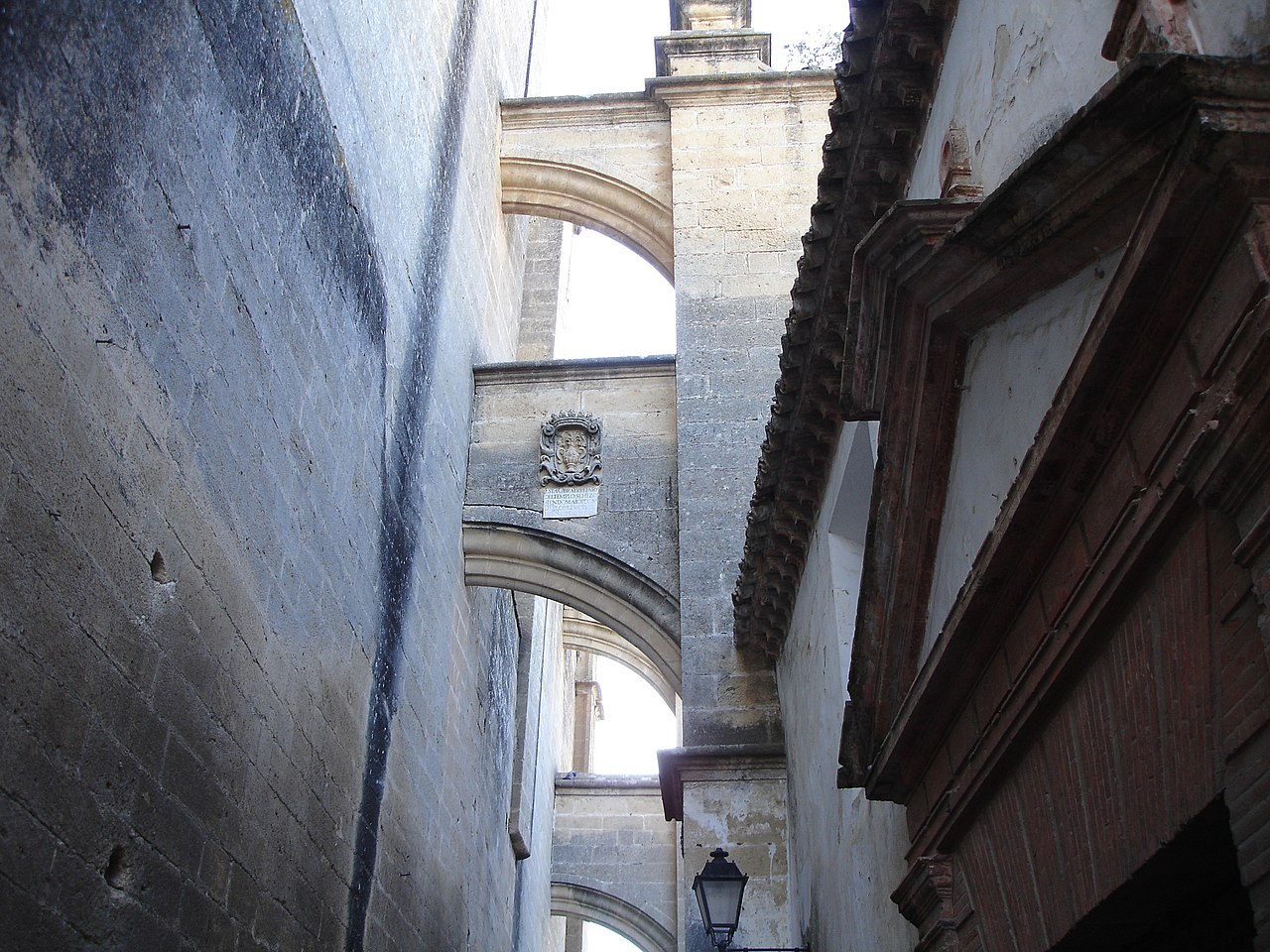

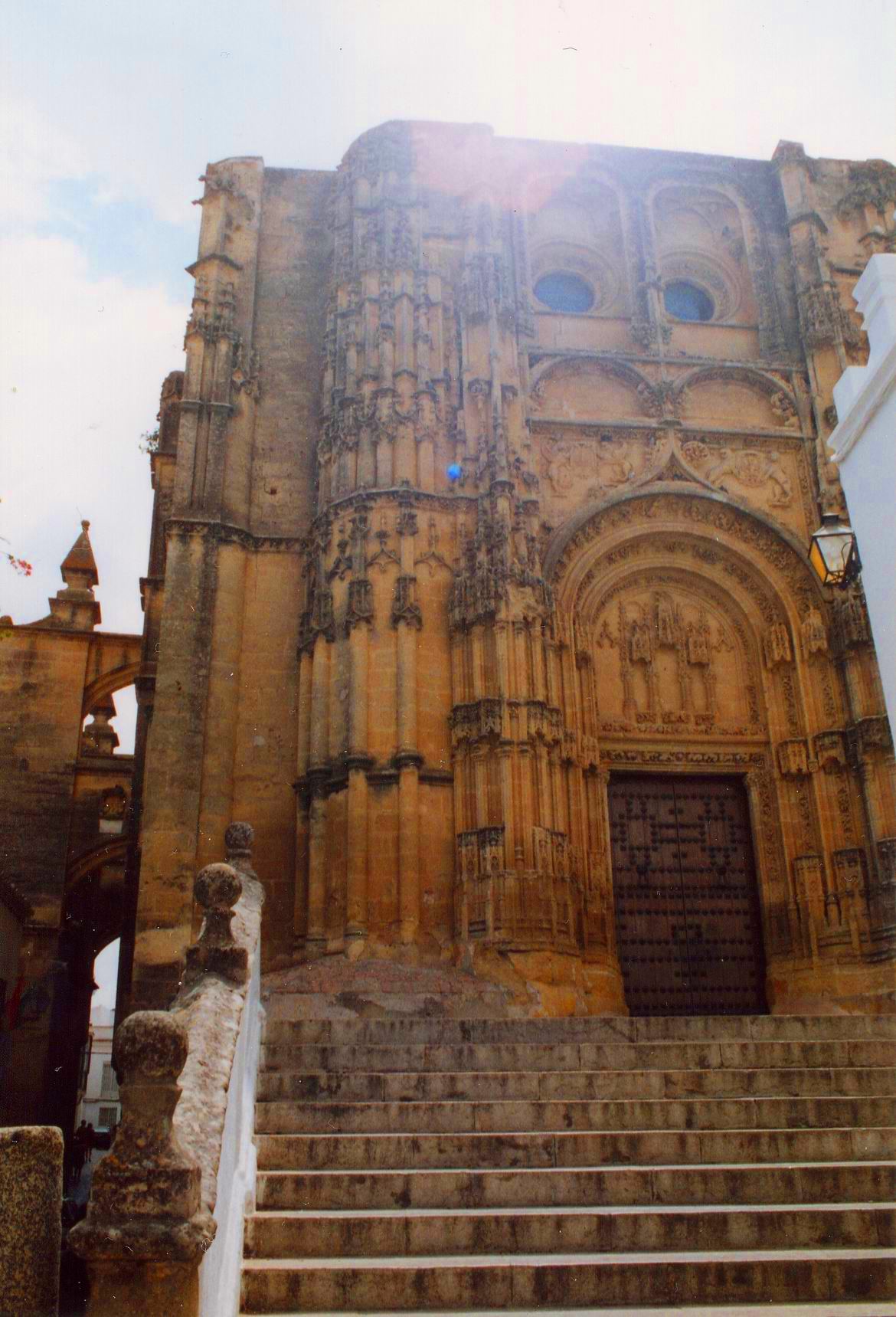


Festivals
September 2026
Festivals this month
- 29 · September San Miguel 📆 Add to my calendar
- September Feria de San Miguel
Rest of the year
- February: Carnaval (15)
- March: Mercado Medieval (20)
- May: Velada María Auxiliadora (20) · Cruces de Mayo
- August: Nuestra Señora de las Nieves (5)
What's on
Street market
•Mercado De Abasto Del Centro
•Mercado de Abastos "María Auxiliadora" — Calle Pérez Galdós (Tu-Sa 09:00-15:00)
Gastronomy
There's no information in this section yet. The village's profile can complete it from the panel.
Trails and hiking
Routes passing through Arcos de la Frontera
There's no information in this section yet. The village's profile can complete it from the panel.
Services
Do you have a business in Arcos de la Frontera? Advertise it for free and go premium whenever you like. List my business for free
Famous people
•Rodrigo Ponce de León y Núñez, noble y militar leonés (1443-1492), X señor de Marchena, III conde de Arcos, II marqués y I duque de Cádiz y I marqués de Zahara
•José Castaño Muñoz, futbolista español
•Tragabuches, bandolero andaluz
•Rafael Bellido Caro, obispo católico español
•Iván Jiménez Villalba, futbolista español
•Carlos Murciano, escritor español
Town hall
Gobierno municipal:
Evolución de la deuda viva municipal:
El concepto de deuda viva contempla sólo las deudas con cajas y bancos relativas a créditos financieros, valores de renta fija y préstamos o créditos transferidos a terceros, excluyéndose, por tanto, la deuda comercial.
Organización territorial:
Pedanías:
Town hall of Arcos de la Frontera
Gobierno municipal: Evolución de la deuda viva municipal: El concepto de deuda viva contempla sólo las deudas con cajas y bancos relativas a créditos financieros, valores de renta fija y préstamos o créditos transferidos a terceros, excluyéndose, por tanto, la deuda comercial. Organización territorial: Pedanías:
Here goes your town hall's profile or your website address. Are you from the town hall? Go premium to complete your profile and edit your village's content. hola@ciudadesypueblos.es
How to get there
- 🚗 35 km from Jerez de la Frontera (about 25 min by car)
- 🚗 62 km from Cádiz (about 44 min by car)
- 🚗 91 km from Sevilla (about 64 min by car)
🧭 Travelling around the villages of Spain: a practical guide — Opening hours, transport, money and customs, before you set off.
- ✈️ 28 km from Jerez de la Frontera airport (about 20 min by car)
- ✈️ 94 km from Sevilla airport (about 66 min by car)
Practical info
🅿️ Where to park
- Where to park · 0.6 km away
- Where to park · 0.6 km away
- Where to park · 0.7 km away
🏧 Nearest cash machine
- Nearest cash machine · 0.5 km away
- Caja Rural · 0.7 km away
- Caixabank · 1.4 km away
⛽ Nearest petrol station
- Moeve · 1.4 km away
- BP · 1.4 km away
- Ballenoil · 1.5 km away
ℹ️ Tourist office
- Centro de Interpretación Ciudad de Arcos · 0.2 km away
- Tourist office · 0.7 km away
- Mirador Pueblos Blancos · 1.5 km away
🔭 Viewpoints
- Balcón de Arcos · 0.1 km away
- Viewpoints · 0.2 km away
- Mirador de las Almenas · 0.2 km away
🏖️ Where to swim
- Playa fluvial embalse de Arcos de la Frontera · 2.8 km away
Buses
57 paradas de autobús en el municipio:
•Corredera
•Camino Bornos - Setenil
•Camino Bornos - Cementerio
•Venezuela - Ecuador
•Av. Constitución - Colegio Juan Apresa
•Las Palomas
•Av. La Paz - Colegio Vicenta Tarín
•Guadalcacín
Pharmacy and health
•Farmacia Farmacia Corredera
•Clínica Médica Juan M. Armario
•Centro de Salud El Pósito — Calle Corredera 36
Wall and news
Log in with your profile to post. Posting on the walls is free.
This wall is still quiet.
Obituaries
There are no obituaries published right now in Arcos de la Frontera.
In loving memory
There are no memorials in Arcos de la Frontera yet.
Videos
Discover Arcos de la Frontera on video: