
Alcover
Tarragona · Cataluña
Alcover (Catalan pronunciation: [əlkuˈβe]) is a municipality in the Alt Camp comarca, in the Province of Tarragona, Catalonia, Spain. It lies at the meeting point of the Camp de Tarragona plain and the foothills of the Prades Mountains, near the valley of the Glorieta. The municipality covers 46.0 km2 (17.8 sq mi) and has a population of 5,362 (register office, 2025) . The territory has archaeological evidence of occupation from prehistory through the Iberian, Roman and late antique periods. Medieval Alcover developed within the lordship of the Archdiocese of Tarragona, and by the late Middle Ages had become a fortified market town. The municipality preserves a substantial historic centre, Renaissance and Baroque architecture, and an important palaeontological collection based on the Middle Triassic Alcover-Mont-ral fossil site.
Sections the premium town hall can edit · Fixed sections of the guide
Origins
Sobre el origen del nombre hay tres teorías:
Proviene de la palabra árabe al-kouar, que significa jefe de tribu.
Proviene de la palabra árabe al-kubeier, que significa el grandecito.
Proviene de una voz prerromana con la raíz erri, que significa lugar.
En los censos de entre 1877 y 1900 se denominaba Alcober.
History
Prehistory and Iberian period:
The oldest known evidence of human presence near Alcover includes Upper Palaeolithic stone tools from the Pont de Goi site. Later prehistoric remains include the Chalcolithic burial cave of Cau d'en Serra, while an Iberian settlement has been identified at the Degotall site. The broader area formed part of the settlement landscape of the pre-Roman Iberian peoples before the Roman conquest of north-eastern Iberia.
Roman and late antique period:
Roman occupation of the present municipality is well attested archaeologically. Rural sites include a pottery workshop at Vila-sec, storage structures and a well at Camí del Molí, Roman pavements and walls at the villa of Burguet, remains at Pont de Goi and Mas de Gassol, and Roman pottery at several other locations. The landscape belonged to the rural territorium of Tarraco, with agricultural estates and smaller settlements connected to the Roman road and production network.
Immediately east of the present municipal boundary, the site of the Cogoll has produced Roman burials, a funerary monument, a bath complex, ceramics, architectural fragments and a coin of Constantine I. Material from the site extends into Late Antiquity, and a Visigothic marble capital has been interpreted as possible evidence of a rural Christian building.
Archaeological synthesis by Josep Francesc Roig Pérez argues that the Alcover area remained inhabited and exploited through late antiquity and the Visigothic period, with occupation probably continuing up to the Muslim conquest of the region in 713–714 and beyond, although the author notes the incomplete state of excavation and dating evidence.
Islamic period and Christian conquest:
The Camp de Tarragona came under Muslim rule in the early eighth century. Archaeological and documentary evidence for Alcover itself during the Islamic centuries is limited. Local historiography associates the place-name with this period, while some sites and place-names in the municipality have also been interpreted as Islamic-period survivals.
Modern local history reports Santa Maria d'Alcover in 1059, while Coromines's documentary sequence begins with Alcouer in a papal bull of 1154. Alcover's incorporation into Christian political structures took place in the context of the conquest of the Camp de Tarragona and the final capture of the Muslim stronghold of Siurana in the mid-12th century.
On 9 April 1166 Alcover received a population charter (carta d'acapte or carta de poblament) from Alfonso II of Aragon, under the ecclesiastical lordship of the archbishop of Tarragona. A market is documented by 1174, indicating the development of Alcover as a local commercial centre between the plain and the Prades Mountains.
Middle Ages:
The medieval town was enclosed by walls and gates. The principal medieval fortifications were constructed between 1316 and 1360. Parts of the walls, gates and towers survive in the historic centre. Alcover's location and fortifications drew it into the Catalan Civil War (1462–1472). After resisting royal forces, the town surrendered on 21 August 1464. Archbishop Pere d'Urrea, a supporter of John II of Aragon, punished the town by executing its municipal jurats, removing privileges and temporarily changing its name to Vilanova del Camp. The privileges were restored in 1476. The modern Carrer de la Bretxa marks the sector where artillery opened a breach in the walls on 21 August 1464.
The war caused severe demographic and material losses, but by the late 15th century the town was recovering.
Sixteenth and seventeenth centuries:
Alcover experienced strong demographic and economic growth during the 16th and early 17th centuries. Immigration, including settlers of Occitan origin, contributed to population growth, while textile manufacture became one of the principal sources of local wealth.
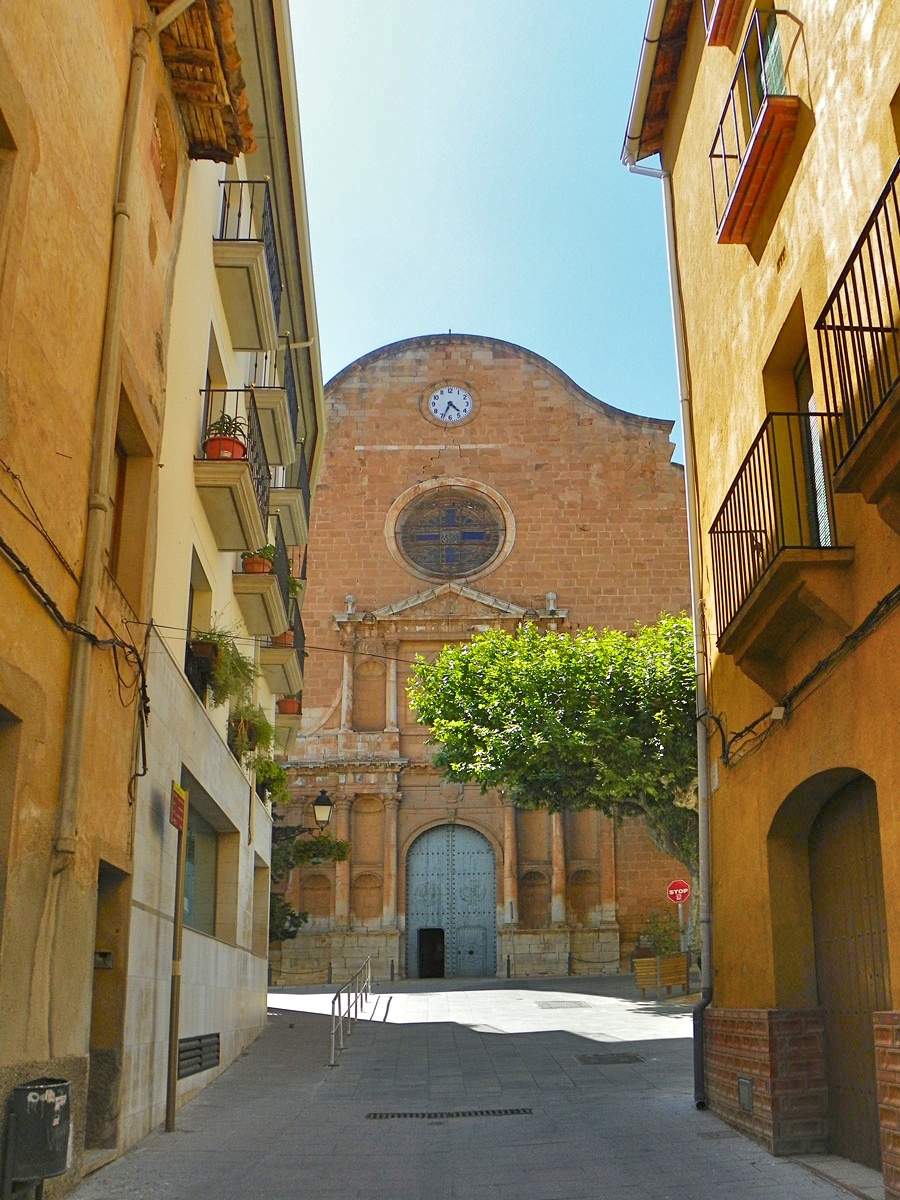
The prosperity of the period produced a major building campaign. The convent of Santa Anna was founded in the late 16th century; a new town hall was built in 1591–1592; and construction of the parish church of the Assumption took place from the end of the 16th century into the early 17th. Numerous substantial private houses were also built or remodelled. The architect Pere Blai, a major figure of Catalan Renaissance architecture, is documented in connection with the churches of the Assumption and Santa Anna.
The same period was marked by violent factionalism and banditry. Rival groups known as the Voltors and Morells became prominent in Alcover and the surrounding region around the turn of the 17th century.
Eighteenth and nineteenth centuries:
After the War of the Spanish Succession, paper manufacturing expanded along the Glorieta valley, where water-powered paper mills became an important part of the local economy.
Administratively, Alcover belonged to the Vegueria of Tarragona until the Nueva Planta reorganization of 1716, after which it formed part of the corregiment of Tarragona until 1833.
During the Peninsular War, the nearby Battle of Valls (also known locally as the battle of Pont de Goi) was fought in February 1809 between French forces under Laurent de Gouvion Saint-Cyr and Spanish forces under Theodor von Reding.
The 19th century brought significant infrastructure improvements. Public street lighting was introduced in 1855, and the Tarragona–Lleida railway reached Alcover in 1863. Streets were paved from the 1860s. Toward the end of the century, the decline of textile and paper manufacturing, together with the phylloxera crisis, contributed to population loss and migration toward urban centres.
Twentieth and twenty-first centuries:
The 20th century saw strong local associational life alongside periods of political conflict. The Cercle d'Amics was founded in 1901. In 1903 the hydroelectric plant on the Glorieta began supplying electricity to Alcover. The agricultural syndicate was founded in 1920. During the Spanish Civil War, religious buildings and objects were destroyed and people associated with the military uprising were killed; the post-war Francoist repression was also severe.
From the 1950s through the 1970s, immigration and new residential development expanded the town beyond its historic walls. The Museu d'Alcover was created in 1966, and the Centre d'Estudis Alcoverencs was founded in 1977.
In the 21st century, development has included an industrial estate, new educational and sports facilities, and the restoration of the former convent of Santa Anna as the Convent de les Arts, a performing-arts and artistic-residency centre.
Monuments
There's no information in this section yet. The village's profile can complete it from the panel.
What to visit
Alcover tiene una importante vinculación con el bandolerismo ya que, a caballo de los siglos XVI y XVII, fue el centro neurálgico de las actividades bandoleras que tenían lugar en estas comarcas, básicamente en el Camp, la Conca y las Garrigues. Esta actividad en Alcover se concretaba en dos bandos enfrentados: los Porrones y los Buitres. El surgimiento del bandolerismo coincide además con un momento de resurgimiento económico de la villa, que se traduce en una transformación arquitectónica y urbanística, cultural, económica y, entre otras cosas, de la fiesta y la cultura tradicional.
Alcover no posee un único elemento de atracción muy fuerte, sino una gran diversidad de elementos interesantes. En este sentido, la Fira de Bandolers hace un esfuerzo para aunar los elementos más representativos: bandolerismo, renacimiento, montañas de Prades y patrimonio etnográfico.
La Feria de Alcover, pues, es una propuesta que retoma el hilo de la edición anterior en el sentido de buscar la proyección exterior del patrimonio histórico y cultural de Alcover.
La Feria de Bandoleros se celebra el segundo fin de semana de octubre.
Gallery




Festivals
September 2026
Festivals this month
- No festivals recorded this month.
Rest of the year
- August: Sant Roc (16)
- October: Feria de Bandoleros (7) · Fiesta Mayor de Alcover (18)
What's on
Street market
Find the day and place of the local street market:
Gastronomy
There's no information in this section yet. The village's profile can complete it from the panel.
Trails and hiking
•Sender Albiol - Cogullons (PR-C 20, 20 km)
•Variant Alcover - Gorg de la Peixera (PR-C 20.1)
•Ermita de Paretdelgada (SL-C 152, 9.210 km)
•El Burguet (SL-C 153, 7.820 km)
•Masies catalanes (SL-C 154, 8.210 km)
•Ruta dels Refugis del Montsant (90 km)
•El Brogit de la Vall (69 km)
•Camí natural Ruta del Glorieta (9.4 km)
•Camí natural Ruta del Glorieta. Variant Molí del Glorieta (6 km)
•Camí natural Ruta del Glorieta. Variant cèquia del Mas de Forés (2.5 km)
•GR 7 Catalunya - Etapa 15 (GR 7, 12 km)
•Itinerari de Salut: Pont de Goi (03, 7.10 km)
Services
Do you have a business in Alcover? Advertise it for free and go premium whenever you like. List my business for free
Famous people
•Kiko Casilla, futbolista español
•Maria Doménech, escritora española
•José Antonio Casilla, jugador de voleibol español
•José Ribera Miró, compositor de zarzuelas español
•Cosme Vidal, escritor español (1869-1918)
•Anton Català i Gomis, pintor español
Town hall
Alcaldía: Robert Figueras Roca
Web oficial: https://www.alcover.cat/
Town hall of Alcover
Alcaldía: Robert Figueras Roca Web oficial: https://www.alcover.cat/
Here goes your town hall's profile or your website address. Are you from the town hall? Go premium to complete your profile and edit your village's content. hola@ciudadesypueblos.es
How to get there
- 🚗 22 km from Tarragona (about 16 min by car)
- 🚗 97 km from Terrassa (about 68 min by car)
- 🚗 98 km from Hospitalet de Llobregat, L' (about 69 min by car)
🧭 Travelling around the villages of Spain: a practical guide — Opening hours, transport, money and customs, before you set off.
- ✈️ 16 km from Reus airport (about 11 min by car)
- ✈️ 93 km from Lleida-Alguaire airport (about 66 min by car)
Practical info
🅿️ Where to park
- Where to park · 0.1 km away
- Where to park · 0.1 km away
- Where to park · 0.1 km away
🏧 Nearest cash machine
- Caixabank · 0 km away
- Santander · 0 km away
- BBVA · 0.1 km away
⛽ Nearest petrol station
- ICOR · 0.7 km away
- Oilprix · 1.3 km away
- LORRY PETROL, SL · 1.7 km away
🔭 Viewpoints
- Viewpoints · 4.8 km away
🏖️ Where to swim
- Piscina Municipal d'Alcover · 0.4 km away
- Piscina municipal d'Alcover · 0.5 km away
Buses
Check the route, times and public transport connections to Alcover:
Pharmacy and health
Find the nearest pharmacy and health centre, with the address and how to get there:
Wall and news
Log in with your profile to post. Posting on the walls is free.
This wall is still quiet.
Obituaries
There are no obituaries published right now in Alcover.
In loving memory
There are no memorials in Alcover yet.
Videos
Discover Alcover on video: